
Section 6. United Nations and its specialized agencies
6.1. General Assembly
General Assembly (GA) occupies a central position as the chief deliberative organ of the United Nations. It is comprised of all Members of the United Nations, each having one vote. It is authorized to discuss full spectrum of issues covered by the Charter. The UNGA convenes on September each year.
On September 10, the UN General Assembly opened its 79th session under the presidency of H.E. Mr. Philemon Yang of Cameroon in New York. The session was guided by the motto: “Leaving no one behind: acting together for the advancement of peace, sustainable development and human dignity for present and future generations”.
The main event of this year’s GA was the Summit of the Future (22-23 September), which resulted in the adoption of the “Pact for the Future”. The Pact, which includes the Global Digital Compact and the Declaration on Future Generations, is the outcome of a multi-year, inclusive process aimed at adapting international cooperation to contemporary realities and future challenges. It focuses on key issues, which will shape the future of humanity, including sustainable development, international peace and security, science, technology and innovation and digital cooperation, youth and future generations, and transforming global governance.
Statements from Central Asia countries at the general debate of the UNGA 79th Session
Statement by the Foreign Minister of the Republic of Kazakhstan
The plight of millions of conflict victims worldwide, across the Middle East, Eastern Europe and parts of Africa, deserve immediate, decisive and collective action. But the UN Security Council’s decision-making process is paralyzed.
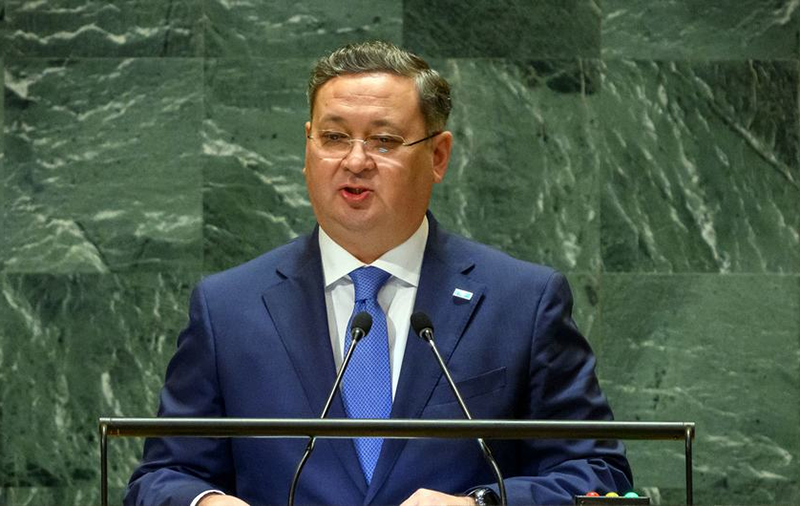
Need for global reforms and strengthened cooperation. “Having annual discussions about reforming global institutions is no longer enough. It is time to enact the change our world so desperately needs”, Mr. M.Nurtleu said. He reminded that last year, from this podium, President of Kazakhstan Kassym-Jomart Tokayev introduced the Initiative of World Unity for a Just Peace and Harmony. “The voices of Middle Powers and developing nations are vital in bridging divides and nurturing a more effective international security architecture”, the Minister underlined.
Escalating rhetoric of nuclear threats. The Minister noted that the pressing risk of another nuclear arms race is exacerbating geopolitical polarization. “Nuclear disarmament and non-proliferation are key pillars of my country’s foreign policy. Kazakhstan is therefore deeply concerned by the escalating rhetoric of nuclear threats. We appeal to all nuclear states to adhere to the Non-Proliferation Treaty and Comprehensive Nuclear-Test-Ban Treaty”, Mr. M.Nurtleu said, adding: “I also urge those countries who have not joined the Treaty on the Prohibition of Nuclear Weapons (TPNW) to do so as soon as possible for the safety”.
Existential threat of climate change. Another existential threat no nation can afford to ignore is climate change. The Minister called on G-20 countries and multilateral development banks to provide green technologies and concessional financing to low- and middle-income countries in line with the Paris Agreement. “Our region stands on the frontline of global warming despite accounting for only 1% of global emissions. Central Asia will face an above average 2.5°С increase in temperatures by 2050”, the Minister noted. He reminded that Kazakhstan will host a Regional Climate Summit in 2026.
Lack of access to safe water. One of the consequences of climate change is water scarcity across the world. “One in four people today lacks access to safe drinking water. If this trend continues, by 2050 more than 5 billion could suffer water shortages”, the Minister noted. “In Central Asia by that time water deficiency will affect 25 to 30% of the population”, the Minister added. He said that as the current Chair of the International Fund for Saving the Aral Sea, Kazakhstan is working with regional partners on a long-term and sustainable cooperation mechanism for the effective use of water and energy resources in Central Asia.
Land-locked countries. As the largest landlocked country, Kazakhstan actively promotes the interests of all LLDC countries. “Despite significant strides, we are still far from implementing the Vienna Program of Action. We are lagging on critical indicators – particularly the adoption of innovative technologies for trade facilitation and the development of transit and transport corridors”, Mr. M.Nurtleu said. He reminded that Kazakhstan is already a bridge for 80% of overland transit cargo traffic between Asia and Europe. “Kazakhstan is committed to strengthening synergies between the Belt and Road project, the Global Gateway Initiative, and the North-South and Trans Caspian International Transport Route corridors”, Mr. M.Nurtleu noted.
Development of Afghanistan. According to the Minister, today’s regional agenda also includes the development of Afghanistan into a stable and predictable state, a reliable trade partner. “In this context, the UN Regional Centre on Sustainable Development for Central Asia and Afghanistan in Almaty will be a game-changer for coordinated SDG delivery”, Mr. M.Nurtleu said.
Upholding human rights. The Minister spoke on importance of upholding human rights and noted that safeguarding women's rights and ensuring children's safety are top priorities of Kazakhstan. “Being one of the champions of repatriation of women and children from conflict zones in the Middle East, Kazakhstan will host an International Conference in 2025 on best practices in the field of repatriation and reintegration”, he added.
Statement by the President of the Kyrgyz Republic
Leading powers are spending huge amounts of money on creating and developing armed forces, increasing arsenals and developing new, more destructive types of weapons. Unfortunately, this is happening in a world where many nations and peoples still do not have access to basic services – water, medical care, education
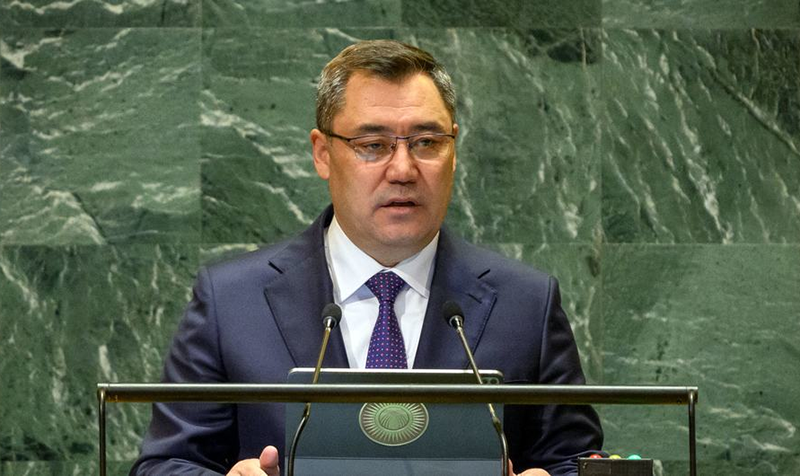
Unprecedented spending on military needs and call for resources to be redirected to global challenges. The President provided data of the Stockholm International Peace Research Institute: global military spending in 2023 increased by 6.8% and reached a record level of US$2.5 trillion per year, or 2.3% of global GDP, the highest amount in decades. The Head of the State underlined that wars and armed conflicts only exacerbate poverty and inequality. “We must ensure that the money that are allocated to wars, destruction, death, could go to creation or to solving global challenges for all of humanity, to help countries in their fight against climate change, to prevent mass displacement and global migration”, Mr. S.Zhaparov stated. Lack of progress in supporting poor countries. The Head of State noted that economic inequality continues to rise. “World leaders have been talking for decades about the need to eliminate poverty, but there is always a lack of willpower. Countries in Africa, South Asia and Latin America continue to face chronic underfunding and a lack of support from the international community”, he stated. The President added that the countries at the very bottom of the economic pyramid need investment in healthcare, education, infrastructure and climate change mitigation.
Cooperation of reach and least developed countries. “The world faces an important choice. We can continue increasing arms, seeking security through military power, or we can choose the path of sustainable development aimed at eradicating poverty and supporting the most vulnerable”, Mr. S.Zhaparov said. He called on developed countries not only to increase the financial assistance to least developed countries, but also to make it targeted, focusing on infrastructure projects and social development. Least developed countries should actively be involved in international initiatives on sustainable development and commit to the efficient use of the provided resources.
Climate change. Mr. S.Zhaparov reminded that one of the most dangerous challenges threatening the very existence of our planet is climate change. “Kyrgyzstan faces a triple challenge - the need to invest in development, reduce poverty and adapt to climate change to achieve carbon neutrality”, the Head of the State underlined. “Each of these areas requires special financing, especially in the context of ensuring climate resilience for our country and vulnerable communities. We are determined to succeed by working together with our partners”, he added.
The Kyrgyz Republic pays special attention to climate issues in the implementation of its national policy and sets an ambitious goal of achieving carbon neutrality by 2050. “More than 95% of our energy is produced mainly by HPPs, which are the main driver towards achieving the goal of zero emissions”, the President noted. He also stated that the country began construction of a modern and innovative city “Asman” on the shores of Lake Issyk-Kul, and the construction of another green city is planned for 2026 in the city of Kemin. Mr. S.Zhaparov also stated that the Kyrgyz Republic supports the UN Secretary-General’s position on the need to reform the international financial architecture and reduce the debt burden for developing countries.
Statement by the President of the Republic of Tajikistan
The controversial geopolitical processes, rapid weaponization, conflicts and aftermath of climate change will undoubtedly give rise to the long-term negative consequences. We need to consolidate joint efforts of the international community to protect security, maintain stability and ensure sustainable development
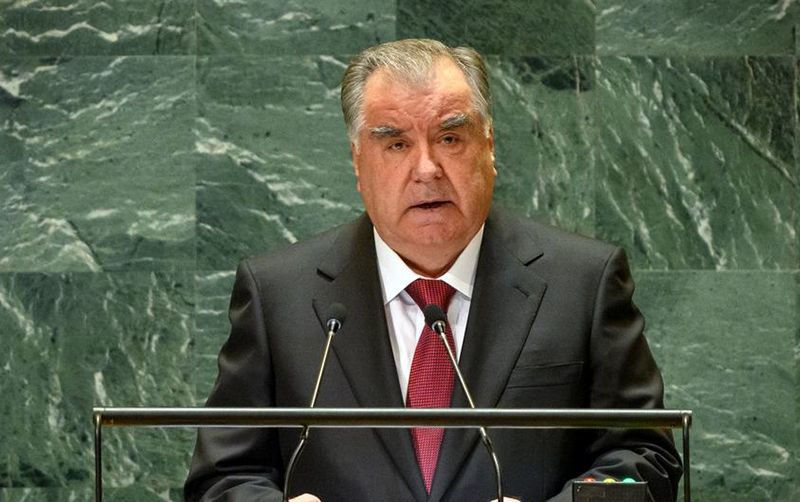
Development is at risk. The President of Tajikistan noted that achieving the SDGs is under threat. “We are witnessing the setbacks in results achieved within the SDGs in many developing countries. In view of this, we need to intensify our efforts to implement the 2030 Agenda in a timely manner and pay particular attention to the financing for sustainable development”, the President stated. “Necessarily, the activities of the international financial and economic system should meet the needs of developing countries so that it can facilitate the timely counterresponse of member states to modern threats and challenges”, Mr. E.Rakhmon added. He highlighted the importance to continue financing countries in need by international financial institutions, especially through the International Development Association.
Digital technologies and artificial intelligence. The Head of State underlined that digital technologies and artificial intelligence pave suitable ways for achieving the SDGs. “Tajikistan is taking measures for the gradual transition to digitalization by adopting a national strategy and relevant legal acts”, he stated. “In this context, I propose to the General Assembly to adopt at its upcoming session a Special Resolution on the Role of Artificial Intelligence in Creating New Opportunities for Socio-Economic Development”, the President added.
Fight against terrorism and rise of Islamophobia. The Head of Tajikistan stated that the international community must take joint and effective actions to withstand the threats of terrorism and extremism, radicalism, cybercrime, trafficking in narcotics and weapons smuggling. Mr. E.Rakhmon noted that Tajikistan constantly carries out joint actions in cooperation with the UN and other international partners to counter security threats and challenges.
Afghanistan. The President called for establishing peace and stability in neighboring Afghanistan and expressed readiness to assist in the development of peaceful life in this country. Mr. E.Rakhmon also called on the international community to spare no effort to help the people of Afghanistan, including regions affected by natural disasters, to prevent a humanitarian crisis in this country.
Climate change and glaciers melting. The President of Tajikistan recalled that climate change is causing the accelerated melting of glaciers and the reduction of river water volume in different parts of the world, including Central Asia. “To date, more than 1,000 out of 14,000 of Tajikistan's glaciers, which are the main source of drinking water in the region, have completely melted, and the pace of their melting is dramatically increasing. This is despite the fact that precipitation and glaciers of Tajikistan make up to 60% of the source of water in Central Asia”, he added.
On the initiative of Tajikistan, the UN has proclaimed 2025 the International Year of Glaciers’ Preservation. According to the President, this creates a “favorable foundation” for developing international cooperation in this area. The President also highlighted that the country currently generates 98% of its electricity from hydropower, ranking it 6th in the world for the share of green energy produced from renewable sources. The President of Tajikistan identified adapting to climate change and combating its negative consequences as one of the global community's top priorities. “We are convinced that the international community succeeds to achieve its common goals and objectives through the development of trustful dialogue, mutual understanding and constructive cooperation”, he stated.

Statement by the Foreign Minister of Turkmenistan
In addressing the global climate agenda, Turkmenistan will be focusing on protection of the natural environment in Central Asia and the Caspian Sea region
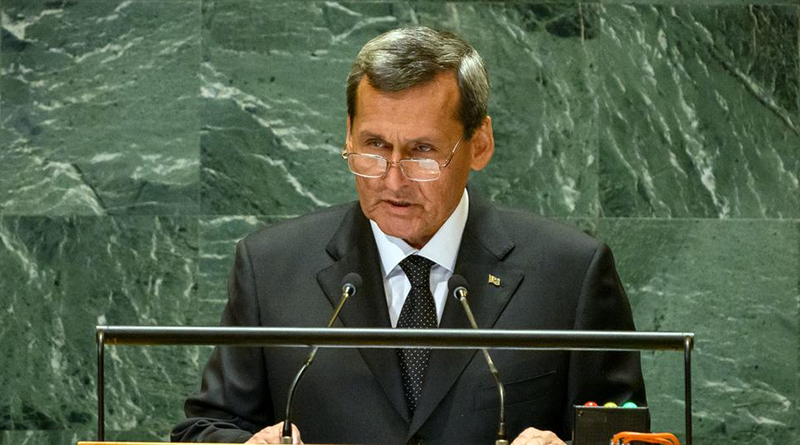
Neutrality and peace. Mr. R.Meredov highlighted that next year Turkmenistan will celebrate 30th Anniversary of the UN General Assembly’s resolution on international recognition of neutral status of Turkmenistan and called to provide neutral countries the status of priority partnership with the UN in its peacekeeping efforts. The Minister highlighted Turkmenistan’s leadership in preparation to the year 2025 declared as the International Year of Peace and Trust.
Solidarity for Afghanistan. Mr. Meredov stressed the role of Turkmenistan in supporting reconstruction efforts in Afghanistan. He mentioned major infrastructure projects such as the Turkmenistan-Afghanistan-Pakistan-India gas pipeline, and the construction of power transmission and fiber-optic communication lines and railways. In addition, the Minister noted the assistance that his country provides to Afghanistan, including construction of social facilities and education of Afghan students in Turkmenistan.
SDGs. Mr. R.Meredov called on the global society to support a number of specific initiatives from Turkmenistan. Those include the Global Framework Program for the transition to a circular economy, Global Atlas of Sustainable Transport Connectivity, and the Alliance for Global Energy Security and Sustainable Development. Minister stressed the commitment of Turkmenistan to overcoming humanitarian crises, protecting motherhood and children, and safeguarding the rights of refugees and stateless persons. Currently more than 32 thousand people, including refugees and stateless persons, have been granted Turkmenistan citizenship.
Environmental protection. The Foreign Minister advocated for more active and extensive UN involvement in saving the Aral Sea and mentioned Turkmenistan’s recent initiatives, including on creating UN Special Program for the Aral Sea Basin. He also called to take comprehensive measures to address desertification and water challenges in the region. According to Mr. R.Meredov, another topic has gone far beyond regional borders is the Caspian Sea issue. He emphasized the need for global cooperation to protect the unique Caspian ecosystem proposing the Caspian Environmental Initiative as a platform for dialogue with international partners.
Global challenges. In his concluding remarks, Mr. R.Meredov voiced his confidence in the UN and its immense capacity to secure global peace, security, and sustainable development. “Turkmenistan will continue contributing to addressing global challenges for the future of the world”, the Minister stated.
Statement by the Foreign Minister of the Republic of Uzbekistan
The air temperature in Central Asia is rising faster than the global average. This creates a wide range of problems, which pose serious risks to food and energy security
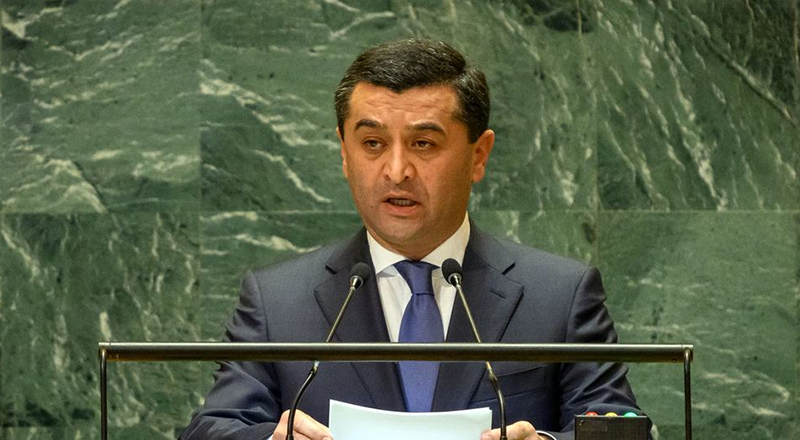
Climate change consequences. According to Foreign Minister, water availability per capita in Central Asia has halved over the past few decades. The Aral Sea disaster continues having an extremely negative impact on ecosystems in all states in the region. “We call on the international donor community to expand projects in the Aral Sea region to mitigate the devastating consequences of this disaster”, he continued and recalled that the Aral Sea became the first region in the world to be granted by the UN the status of a Zone of Environmental Innovation and Technology. “Our adanced experience could benefit other countries facing similar problems”, Mr. B.Saidov added.
Global challenges and the role of the UN. The Uzbek Foreign Minister stated that wars and conflicts, triple planetary climate crisis, worsened world economy and technological gap are affecting all countries without exception. In this context, he called to preserve the great potential of multilateral cooperation developed over decades within the UN and other international organizations. “We firmly believe that the United Nations must remain central in addressing the challenges of the 21st century”, Mr. B.Saidov added.
Actions at national level. The Minister also highlighted that resolving global issues at the national level is crucial for maintaining stability and the well-being and prosperity of any country. “The consistent implementation of the SDGs has been identified by the President of our country as the cornerstone of Uzbekistan's state policy”, Mr. B.Saidov stated. According to him, Uzbekistan has made significant progress in reducing poverty, improving public access to education, transitioning to a green economy, and promoting gender equality in recent years. “Our GDP has more than doubled, and the poverty rate has fallen to 11%”, he added.
Women's right. The Minister noted that empowering women and girls is a key element of state policy. According to him, Uzbekistan has made notable progress in ensuring gender equality, ranking among the top five countries in this regard.
Regional cooperation. The Minster stated that Central Asia remains top priority in Uzbekistan's foreign policy. Today the region is firmly focused on connecting to major global markets and revitalizing the Great Silk Road.
Afghanistan is an integral part of Central Asia. “Unfortunately, the international community has been unable to take measures capable of reversing the challenging situation in this country”, the Foreign Minister noted. According to him, Uzbekistan is pursuing a pragmatic policy towards Afghanistan. “We will continue contributing to Afghanistan’s economic reconstruction and the development of its transport and energy infrastructure”, Mr. B.Saidov added.
Selected Resolutions on Water, Environment and Development Adopted by the UNGA 79th Session
Sustainable Development: UNEP Report (A/79/437/Add.7); Zone of peace, trust and cooperation of Central Asia (A/79/L.1); Sustainable development: disaster risk reduction (A/79/437/Add.3); World Lake Day (A/79/L.39); Agriculture development, food security and nutrition (A/79/443); International cooperation on humanitarian assistance in the field of natural disasters, from relief to development (A/79/L.33); International Day of the Snow Leopard (A/79/L.40); Oceans and the law of the sea (A/79/L.37); Sustainable development: protection of global climate for present and future generations of humankind (A/79/437/Add.4); Sustainable development: Convention on Biological Diversity (A/79/437/Add.6); Sustainable development: Harmony with Nature (A/79/437/Add.8); Sustainable development: ensuring access to affordable, reliable, sustainable and modern energy for all (A/79/437/Add.9); Sustainable development: combating sand and dust storms (A/79/437/Add.10); «Agriculture development, food security and nutrition (A/79/443).
Development and support
Scientific-Information Center ICWC