
Section 3. IFAS and other regional organizations in Central Asia
3.1. International Fund for Saving the Aral Sea
The International Fund for Saving the Aral Sea (IFAS) was established by the decision of the Heads of the Central Asian states on the 4th January of 1993 with the aim of developing and funding the environmental and applied research projects and programs in order to improve the ecological situation in the areas affected by the Aral Sea catastrophe and to address the socio-economic issues in this region. The organizational setup of IFAS is depicted in the diagram below.
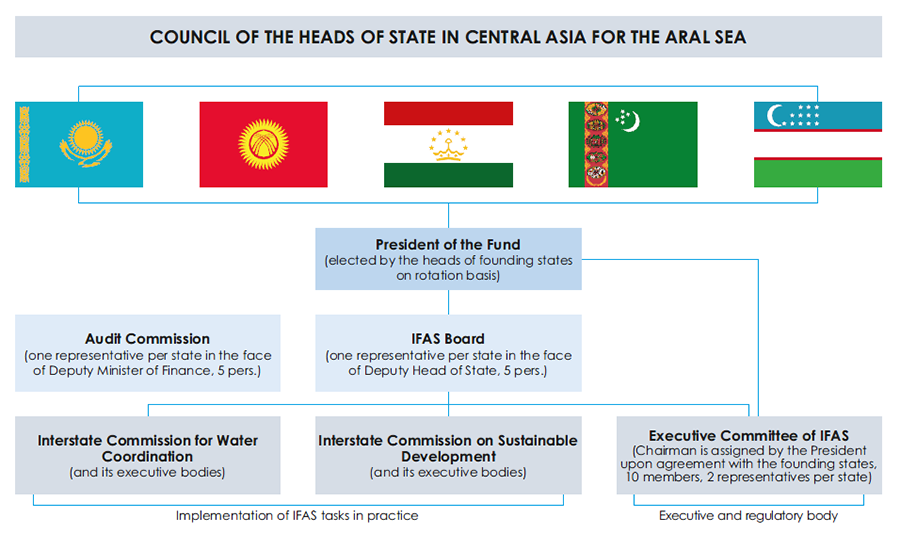
The chairmanship in IFAS is rotated every three years. Since 2024, the chairmanship of IFAS has passed to the Republic of Kazakhstan . The Head of State, Kassym-Jomart Tokayev, has been elected President of IFAS until the end of 2026 .
3.1.1. Implementation of Initiatives of the Presidents of CA States Voiced at Summits of the Heads of IFAS Founding States in Turkmenbashi (2018) and Dushanbe (2023).
During the IFAS Summits in Turkmenbashi (2018) and Dushanbe (2023), the Presidents of the Central Asian states advanced a series of strategic initiatives. These proposals address a broad spectrum of regional cooperation, spanning water management, environment, energy, and socio-economic development. Progress on these initiatives is systematically reviewed through regular meetings of the Interstate Commission for Water Coordination (ICWC).
Information on implementation of these initiatives in 2024 is given in "Executive Committee of IFAS and its National Branches", "ICWC of Central Asia" and "Key Water Developments in the Countries of Central Asia".
3.1.2. IFAS Board
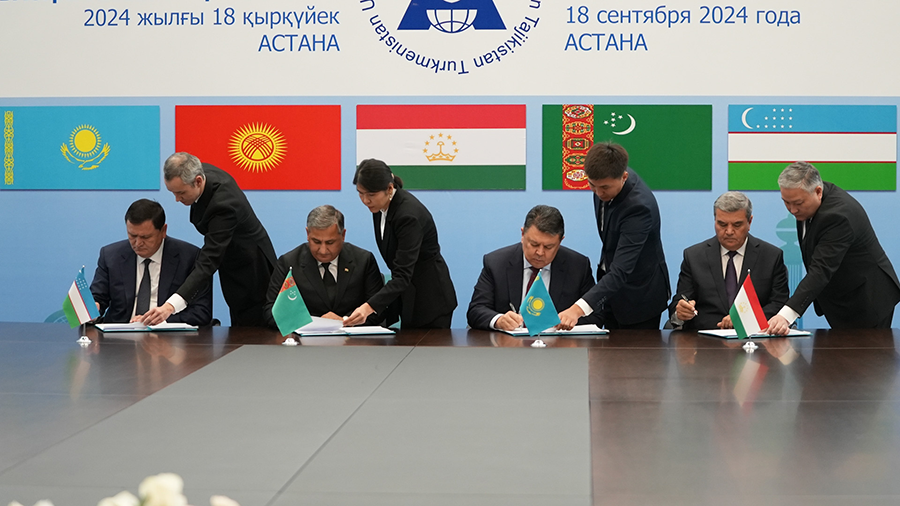
The first meeting of the Board of IFAS, chaired by the Republic of Kazakhstan, was held on 18 September in Astana. Following the meeting, several resolutions were adopted and the EC IFAS work plan was approved. The plan outlines 10 thematic areas and over 40 activities designed to fulfill the mandates of the Heads of Founding States and the IFAS President. Efforts will focus on strengthening the Fund’s institutional and legal frameworks, with key priorities including the ongoing implementation of ASBP-4 and REP4SD-CA.
3.2. Executive Committee of IFAS and its National Branches
3.2.1. Executive Committee of IFAS
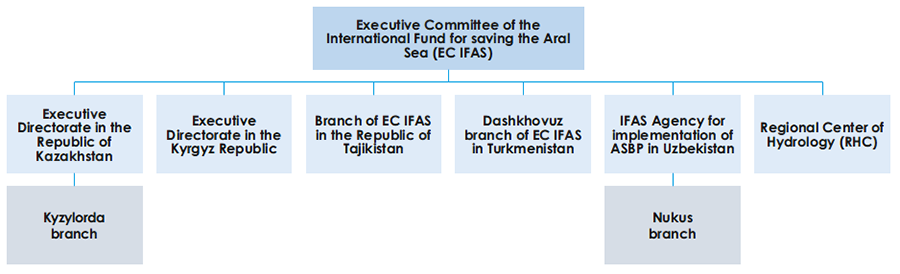
The Executive Committee of the International Fund for Saving the Aral Sea (EC IFAS) was formed by a decision of the Interstate Council on July 13, 1993. It serves as a platform for dialogue between the CA countries and the international community.

Mr. Askhat Orazbay has been appointed chairman of the Executive Committee of IFAS.
Activity of EC IFAS in 2024
Improvement of the institutional and legal framework of IFAS. Two meetings of the Working Group (WG) on the improvement of the institurional and legal framework of IFAS were held in 2024: (1) 12th meeting, the outcomes and recommendations of which were submitted to the members of the IFAS Board (September 4, online); (2) 13th meeting, which yielded a consensus-based draft structure for the reorganized entity and a work plan for 2025 (December 12-13,
ASBP-4. Pilot project implementation in Aral Sea Basin countries - aligned with ASBP-4 objectives - was discussed in high-level meetings throughout the year. Key consultations included sessions with the OSCE (May 2), ADB (August 12), EU (September 10), and international development partners (September 18). Notably, discussions with the AFD were held in Astana (August 22) and on the sidelines of the One Water Summit in Riyadh (December 3). Concurrently, the progress of regional projects integrated into the ASBP-4 framework remains under active monitoring.
Cooperation. The priorities of Kazakhstan’s IFAS Chairmanship were shared with EU Member State Ambassadors (March 26, Astana). Furthermore, technical consultations were held with Art Work Design Kft regarding the development of an integrated information exchange and coordination system for regional water management (August 8, Astana). EC IFAS signed Memoranda of Understanding with: (1) GIZ (September 18); (2) IWMI (16 November, COP29, Baku). EC IFAS also took part in the second international steering committee meeting for the preparation of the One Water Summit (May 21, Bali) .
EC IFAS signed Memoranda of Understanding with: (1) GIZ (September 18); (2) IWMI (16 November, COP29, Baku). EC IFAS also took part in the second international steering committee meeting for the preparation of the One Water Summit (May 21, Bali).
Events. Jointly with SIC ICWC and with World Bank support, EC IFAS organized the subregional session “Transboundary Water Cooperation in the Aral Sea Basin for a Better Future.” Its conclusions were integrated into a broader synthesis on Central Asian water security at the 10th World Water Forum (May 22, Bali). Furthermore, at COP29, the Committee hosted a side event "Central Asia on the Way to Enhancing the Efficiency of Transboundary Water Resources Management in the Aral Sea Basin under Climate Impact" (November 19, Baku).
EC IFAS participated in: (1) ICSD meeting (March 28, Astana); (2) the 86th ICWC meeting (April 12, Shymkent); (3) 6th Central Asian Climate Change Conference (May 27, Almaty); (4) 14th International Drainage Workshop "Modernization of Irrigation and Drainage Systems for Climate Change Adaptation and Sustainable Development" (May 30-June 1, Dushanbe); (5) session "Water, Energy and Food in Central Asia: Partnerships and Projects for Sustainable Development" during the EDB Business Forum (June 27, Almaty); (6) 3rd meeting of the RWG on the implementation of the Regional Climate Change Adaptation Strategy for Central Asia (November 29, Bishkek) and others.
Source: EC IFAS
3.2.2. Regional Center of Hydrology
The Regional Center of Hydrology (RCH) of EC IFAS was founded by the decision of the IFAS Board on August 23, 2002 in order to improve the system of hydrometeorological forecasting, environmental monitoring and data exchange between the National hydrometeorological services in the region.
3.2.3. IFAS Executive Directorate in Kazakhstan
The IFAS Executive Directorate in Kazakhstan facilitates the resolution of critical issues and coordinates practical measures to improve the water-related, socio-economic, and environmental conditions within the Kazakhstani area of the Aral Sea Basin. The focus areas of its activities and actions are directly aligned with those of EC IFAS and the ongoing operations are coordinated with the authorized representatives of Kazakhstan in EC IFAS.
Activity in 2024
Improvement of the institutional and legal framework of IFAS. ED IFAS took part in the 12th (September 4) and 13th (December 12-13) meetings of the WG.
ASBP-4. ED IFAS, in consultations with relevant government bodies, scientific and academic institutions, NGOs, and international partners, developed a Project Portfolio comprising 46 proposals aligned with the main directions of ASBP-4. During the period 2020-2024, 3 projects (costing $444.57 thousand) were implemented under Direction 1; 4 projects ($502.6 thousand) under Direction 2 and 3 projects ($212 thousand) under Direction 3.
Projects. Under the USAID-funded ERAS-1 project ($1.35 million, 2021–2024), restoration efforts on the dried Aral seabed progressed with black saxaul planting and site surveys. A major regional conference in Almaty (20 November) showcased best practices in 'green belt' creation and community engagement through the Aral Geopark initiative. Furthermore, bilateral cooperation was strengthened during the 4th Uzbek-Kazakh Working Group meeting, which prioritized the development of regional protected areas (November 21, Almaty).
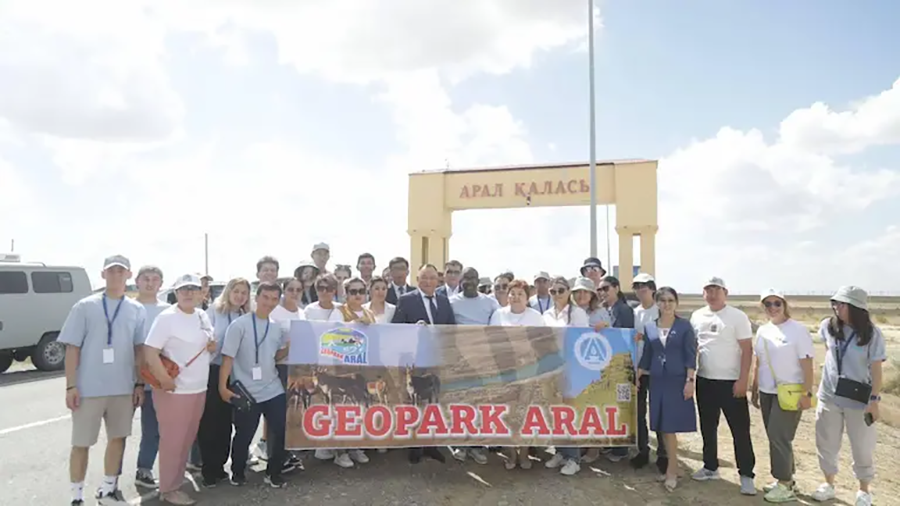
The Geopark Aral project has been included in the list of environmentally-oriented projects under ASBP-4, aligning with SDG 8. The 1st Geopark Aral in Kazakhstan and CA was officially launched on 15 August. Within the framework of the project: (1) cooperation has been strengthened with the UNESCO Global Geoparks Committee and the National Commission of the Republic of Kazakhstan for UNESCO and ISESCO; (2) the website https://geoparkaral.kz/ has been launched, and tourist routes and maps are under development; (3) Memoranda of Understanding have been signed with partners, and a formal request was submitted to include the project in the Tourism Development Plan of Kazakhstan (2023-2029); (4) inter-agency working groups have been established with the Committee on Geology and the Akimat of Kyzylorda Region; (5) Cooperation Agreement was signed with the Yangantau Geopark (Republic of Bashkortostan). An international conference on geoparks will be held in Kyzylorda in May 2025.
In collaboration with the NGO 'Aral Tenizi', a series of events were held at the Eco-Aral Scientific and Tourist Centre (south coast of Lake Kamystybas) to develop an ethno-village (ethno-aul). This site is set to become a key feature of the Aral Geopark tourist route (May 20–24).
15 August, Source
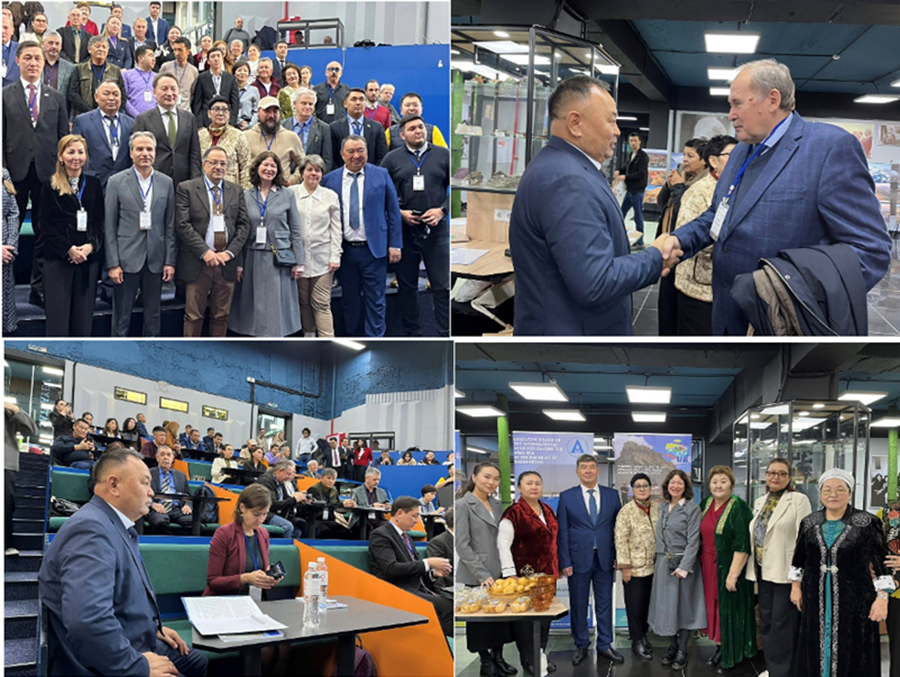
28-29 November, Source
Under the 'North Aral Sea (NAS) Development and Revitalization' project (a joint initiative of the World Bank and the Government of Kazakhstan), consultations were held to review the project’s feasibility study. The primary focus was on evaluating technical options to increase and stabilize water levels in the Northern Aral Sea (January 17 and July 25, Almaty).
In the Aralsk region, a survey of seasonal saline-marsh lakes in the city of Aralsk was conducted to support their reclamation and greening, as well as a study of groundwater levels in areas of backfilled lakes with social infrastructure facilities. As a result, 5 lakes were included in the Project Portfolio of ED IFAS. The absence of a drainage system was identified as a risk to the building's safety (May 20-24).
In cooperation with: (1) GIZ, the construction of 42 new reservoirs in Kazakhstan was analyzed to bolster irrigation development and flood protection; (2) Kazphosphate LLP and the TOO “Kazakh Research Institute of Water Management”, a joint project on the use of phosphogypsum as a soil ameliorant on degraded lands of the Aral Sea region is planned.
Capacity Building. Jointly with: (1) Satbayev University, a summer school was organized for second- and third-year students (May 29-31) at the Kasamansky water intake, the northern shoreline and cliffs (chinks) of the Northern Aral Sea, the Aklak hydraulic structure, and the OASIS and Eco-Aral scientific and production centers on the shore of Lake Kamystybas; (2) Kazakh National University (KazNU), the 6th Summer School on the Aral Sea was held (August 12-22).
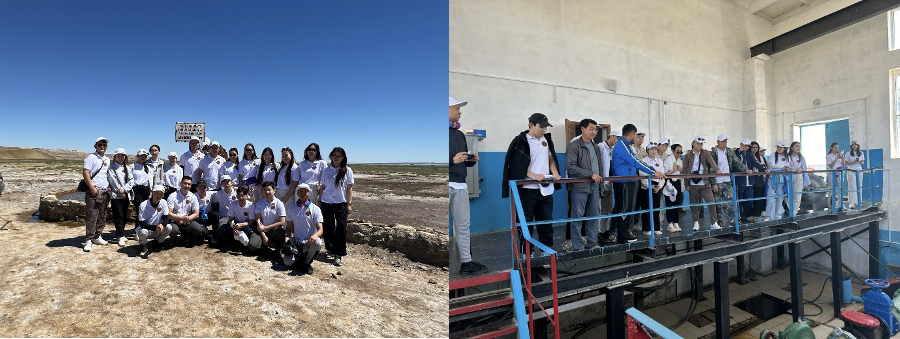
29-31 May, Source
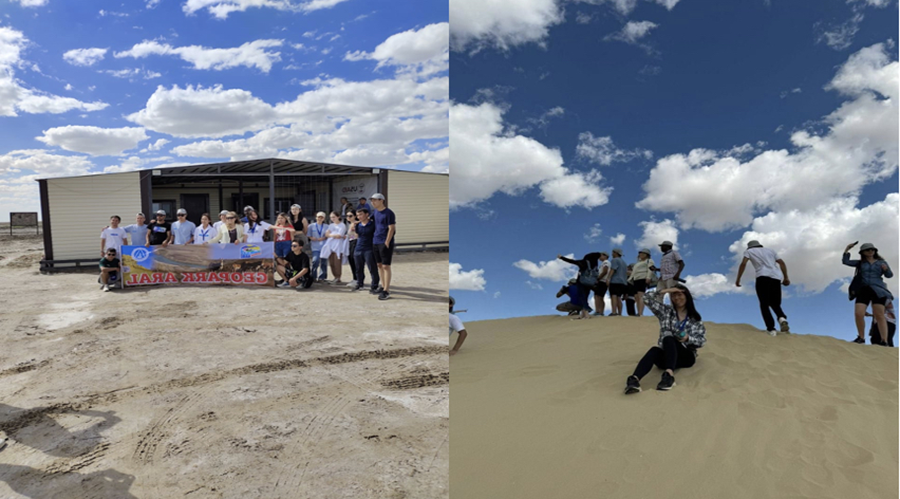
12-22 August, Source
At the initiative of the Ministry of Water Resources and Irrigation, and in partnership with the OSCE Programme Office in Astana and IWAC, efforts were underway to upgrade water education curricula (August 12-16).
Cooperation. ED IFAS signed Memoranda of Cooperation with: (1) Freedom Bank Kazakhstan to implement environmental projects in the Kazakh part of the Aral Sea region; (2) the Kazakh Research Institute of Water Management; (3) the National Chamber of Entrepreneurs "Atameken"; (4) KazTransGas Aimak; (5) the Public Association "Turan Depression - Aral Sea".
A meeting with the Ambassador of France to Kazakhstan addressed the prospects of groundwater utilization for land reclamation on the Aral Sea's former seabed (February 14).
Events. ED IFAS organized: (1) the volunteer environmental project Syr Qorgany Sekseuil focusing on planting saxaul seedlings on 8 hectares of the dried bottom of the Aral Sea (March 1-3); (2) a working mission to the Aral Sea region on the occasion of the Aral Sea Day (March 25-30); (3) an environmental foresight expedition with the participation of Ambassadors from 19 EU countries, the United Kingdom and the United States, as well as representatives of IFAS and state authorities to explore joint approaches to addressing the pressing challenges of the Aral Sea region in the context of global initiatives (April 12-17); (4) a visit of the French delegation to Almaty and Kyzylorda Region, which resulted in a set of proposals addressing current water and environmental challenges in Kazakhstan and the preparation of materials for the One Water Summit (June 11-16).
ED IFAS representatives also took part in: (1) the 6th Annual Water and Peace Seminar on conflict and cooperation dynamics around large infrastructure in transboundary basins (April 17-18, Almaty); (2) the International Conference "Enhancement of Cooperation on Water Security between the Central Asian Countries" (April 25-26, Dushanbe); (3) the Science and Technology Forum held within the 3rd High-Level International Conference on the International Decade for Action "Water for Sustainable Development" 2018-2028, with a presentation "Innovative technologies for afforestation on the drained bottom of the Aral Sea" (June 10, Dushanbe); (4) the roundtable on environmental innovations and technologies implemented in the Aral Sea region, and on the development of cooperation within the UNCCD, featuring a presentation "Current Approaches to Combating Desertification and Drought as Measures for Climate Change Mitigation and Adaptation in the Aral Sea Region" (June 28, Aralsk); (5) COP29 (November 11-22, Baku, Azerbaijan); (6) the 27th Session of the SPECA Working Group on Water, Energy and Environment, with a presentation "Developing Cooperation on Hydraulic Structure Safety as a Foundation for Central Asia’s Green Economy Algorithm" (November 25, Dushanbe); (7) the conference "The 2024 Flood and Current Water Management Challenges in Kazakhstan", with a presentation "Experience in Managing Transboundary Water in the Syr Darya Basin under umbrella of IFAS" (December 3, online), and others.
Source: ED IFAS in Kazakhstan
3.2.4. Agency for implementation of IFAS projects in Uzbekistan
The GEF Agency of IFAS, established in 1998, is an IFAS working body with the status of an international organization, which is accredited by the Ministry for Foreign Affairs of Uzbekistan as a representative office of EC IFAS in Uzbekistan.
Activity of GEF Agency in 2024
Projects in the South Aral Region. In collaboration with the EC IFAS Nukus Branch, resources are deployed to address the Aral Sea crisis. Based on the 2022–2024 Aral region socio-economic development plan (Resolution of the Cabinet of Ministers No. 42-F of 07.02.2022 ), the following projects have received funding:
• "Construction of small local water bodies in the Amu Darya Delta. Phase II" for two sub-projects: (1) "Reconstruction of the Muynak Canal from PK0+00 to PK250+00 in Muynak District (UZS32.432 billion, contractor – SUE "Zarafshon Maxsus Suv Qurilish"). The canal, 25 km long, with a flow capacity of 44 m³/s, was accepted by the State Commission on 15 March 2024; (2) "Completion of construction of diversion canals, enforcement of tail-water and repair of mechanical equipment at the existing outlets of the Rybache reservoir, plus reconstruction of the tail part of the dam, including construction of a new section from PK71+00 to PK122+00 to prevent canyon-formation processes" (UZS20.511 billion, contractor – OOO "Elikkala Maxsus Suv Pudrat"). The work is complete and awaiting final sign-off.
• Afforestation in two sites: (1) "Protective afforestation in Akhantai site by local trees and shrubs" to the north-east of Muynak town on an area of 8,703 ha (UZS3,374.64 million, contractor - Muynak State Hunting Estate). A total of 8,731.5 ha were commissioned; (2) "Protective afforestation in Akkum side by local trees and shrubs" to the north of the Sudoche Lake system on an area of 2,082 ha (UZS3,384.085 million, contractor – Kungrad State Forestry). Works have been completed, and the acceptance is finalized.
• At the expense of Uzbekistan’s investment funds, the project “Reconstruction of a road dam (10.6 km) around Maipost Lake and construction of a spillway structure (capacity 1,250 m³/s) on the Amu Darya River (Akdarya) and measures to prevent canyon-formation processes in Domalak Lake”. (UZS460.471 billion, general contractor – Ko'prik Qurilish JSC). As of 15 December 2024, works worth UZS395.401 billion (89.36%) have been completed.
Preparatory activities are currently underway for the project "Construction of an irrigation system on the dried Aral Sea bed to protect green cover, develop livestock farming and its forage base, and establish essential wildlife habitats" (funded by Almalyk MMC JSC at UZS 4 billion and Uzbekneftegaz JSC at UZS 3 billion; contractor – Ko'prik Qurilish JSC). In 2024, the project documentation was approved by the Scientific and Technical Council ; UzGIP LLC finalized the Environmental Impact Assessment (EIA); the Environmental Clearance No. 01-02/02-1001 of 13.09.2024 was issued; and UZS703.259 million in funding was disbursed.
Projects under coordination by the GEF Agency of IFAS: (1) “National Water Resources Management Project in Uzbekistan”: Phases 1 (2016-2019) and 2 (2020-2023) have been completed. A Project Agreement between the Governments of Uzbekistan and Switzerland for Phase 3 ($3.55 million, 2024-2027 ) was signed on 3rd of June. In 2024, the Agency contributed to drafting the Water Code of Uzbekistan; (2) “Monitoring of biodiversity of wetlands in the South Aral Region”: the latest phase was completed in 2023; in 2024, a new project proposal was submitted to donors for funding.
Cooperation through regional projects. The GEF Agency of IFAS was engaged in a number of project events, including: (1) meetings of the Regional Coordination Committee and related workshops of the "USAID Regional Water and Vulnerable Environment Activity Project"/WAVE ($24.5 million, 2020-2025); (2) two meetings of the Uzbek-Kazakh Working Group as part of the "Environmental Restoration of Aral Sea II"/ERAS II (USAID, 2022-2025); (3) ten training sessions on “Climate-Resilient Integrated Water Resources Management in Central Asia”, including delivery of a lecture on “IWRM in Central Asian Countries: International Water Law and Its Application in the Region” as part of "Ecologically-Oriented Regional Development in the Aral Sea Region"/ECO-ARAL (2021-2024, commissioned by BMZ and implemented by GIZ).
As part of: (1) “Conservation and Sustainable Management of Lakes, Wetlands, and Riparian Corridors as Pillars of a Resilient and Land Degradation Neutral Aral Basin Landscape Sustainable Livelihoods” (2022-2026, UNDP-GEF, $3,552,968), support was provided for the recruitment of experts under Component I “Coordinated water resources management as a basis for achieving land degradation neutrality (LDN) in critical areas of the ASB biodiversity”; (2) “Climate Change and Resilience in Central Asia” (UNDP/EU), contribution was made to policy briefs for Uzbekistan across four sectors (disaster-risk reduction, water resources, energy, agriculture), identifying analytical and research gaps and providing recommendations to address them; (3) “Preparation and Delivery of Trainings on Integrating Climate Change Adaptation into Water Planning and Development of a Training-of-Trainers (ToT) Programme”, contributed to training sessions and toprogramme and training manual for trainers.
The GEF Agency keeps exchanging with the International Innovation Center for the Aral Sea Region, focusing on their latest initiatives and innovations.
Activities in support of IFAS. The GEF Agency took part in briefings and coordination meetings of EC IFAS and its national branches, as well as in activities of the Working Group on institutional and legal improvement of IFAS (see details in “EC IFAS”). The ongoing activities of the Agency were presented at meeting with the Chairman of EC IFAS (April 6).
Political and civil engagement. The GEF Agency took part in: (1) the event “Protection of Wetland Sites as a Key Factor of Environmental Stability” (February 2); (2) meetings of the Expert Group of the Senate Committee of Uzbekistan on the development of the Aral Sea region and environmental challenges (January 12, February 28, April 25); (3) the Plenum of the Central Council (June 25) and a meeting of the Executive Committee of the Tashkent City Council (December 20) of the Ecological Party; (4) the Plenum of the Central Council of the Uzbek Ecological Movement (March 30).
At the request of Uzbek ministries and agencies, the Agency developed proposals and analytical reports. It took part in the International Expert Commission in accrediting curricula of TIIAME and securing the ASIIN Quality Seal.
Cooperation. As part of the Global Water Partnership (GWP), the Agency contributed to the AWC publication “Insight into Asian Water, Vol. 2 (2024)” , which was launched at the 10th World Water Forum in Bali. The team took part in GWP webinars on Biodiversity and Drought Management and collaborated with GWP partners to support the Swedish Aral Sea Society in designing a Master’s program in 'Sustainable Development and Sustainability Science'.
The GEF Agency, as a member of: (1) AWC , participated in the 20th meeting (held during the 10th WWF) and 21st meeting (online) of the AWC Board; (2) the Asia-Pacific Water Forum (APWF) , participated in the 31st (January 18, online) and 32nd meetings (October 18, Bangkok) of the APWF Governing Council, at which the APWF Network Action Plan for 2024-2027 was approved, and contributed to the Asia and the Pacific Regional Synthesis Report ; (3) ICID , took part in events organized for a group of international consultants under the WASAG programme to launch the publication “Recommendations for Farmers on Soil and Water Management in Salt-Affected Areas” (https://www.fao.org/3/cc4200en/cc4200en.pdf). Meetings were organized with the Uzbek ministries of water management and agriculture and the Research Institute of Farming in southern regions, as well as seminars on “Soil and Water Management in Salt-Affected Areas of Karakalpakstan” (March 20, Nukus; March 21, Chimbay). Mr. Sokolov delivered a video address at the “Technical Preparatory Meeting: Towards a High-Level Dialogue under the WASAG Programme” (April 29, Rome, online).
The GEF Agency also facilitated signing a Memorandum of Cooperation between the Uzbek Ministry of Water Management and Dayu Irrigation Group Co., Ltd. (China) on water saving (September 10).
Events. The GEF Agency participated in: (1) International Conference on Climate Change and Adaptation, with a presentation “Analytical Assessment of the Intensity of Climate Change Across the Regions of the Republic of Uzbekistan” (May 6-7, Tashkent); (2) 10th WWF “Water for Shared Prosperity” (May 18-24, Bali, Indonesia); (3) the roundtable “Optimizing Water Use – a Common Path Toward Sustainable Regional Development” (June 12, Dushanbe); (4) Anniversary International Scientific and Practical Conference “Land Reclamation and Water Management – the Foundation of Food and Environmental Security”, with a presentation “Systematization of the Environmental Situation as a Path Toward Developing Effective Measures to Stabilize Degrading Ecosystems and Biodiversity in the Aral Sea Zone” (October 9-11, Moscow); (5) Scientific and Practical Conference “Water in Central Asia: the Future Through Cooperation”, dedicated to the 90th anniversaries of V.A. Dukhovny (posthumously) and N.K. Kipshakbayev and the 80th anniversary of R.A. Giniyatullin, featuring a presentation titled “Developing a Conceptual Framework for Solving the Aral Sea Crisis” (November 8, Tashkent); (6) session “Sustainable Water Resources: Innovation and Technology” (November 18, Baku, online); (7) Conference on Ecosystem Restoration of the Dried Bottom of the Aral Sea (20 November, Almaty); (8) 3rd International Scientific and Practical Conference “Current State and Innovative Approaches to Land Reclamation and Irrigated Agriculture”, with a presentation titled “The Water Sector and Irrigated Land Reclamation in Uzbekistan” (November 22, Dagestan State Agrarian University named after M.M. Dzhambulatov); (9) workshop “Enhancing Climate Resilience in the Water, Agriculture, and Energy Sectors of Uzbekistan through Sustainable Finance and Private Investment” (November 25); (10) Regional Consultative Meeting on the Feasibility and Conditions for Establishing a UN Special Program for the Aral Sea Basin Countries (November 30 - December 1, Ashgabat); (11) Consultative Workshop “Strengthening Economic, Financial, and Technological Aspects of Water Security in Uzbekistan” (December 11, Tashkent), etc.
Более подробно информацию о мероприятиях с участием Агенства МФСА см. по ссылке Новости — Агентство МФСА.
Media outreach. Activities of the GEF Agency in 2024 were widely covered by mass media and online platforms, including: KZ24 TV Channel (January 6); News ("Khabar") of the Karakalpakstan Television and Radio Company (January 12); Yangi Uzbekistan newspaper (February 16); Rossiyskaya Gazeta (April 8); Dunye Boylab TV Channel (May 6); Darakchi-Plus No. 18 (May 2), No. 19 (May 9), and No. 20 (May 16); the USAID Regional Water and Environment Project (July 31); PLOV Information Portal (August 19 and 26); Vesti.UZ (August 21); UzTREND Information Portal (August 25); Deutsche Welle (December 3); and Vremya, a socio-political newspaper of Kazakhstan (December 14) and others.
Publications are available here.
Source: GEF Agency of IFAS
3.3. ICWC of Central Asia
Established on February 18, 1992, the Interstate Commission for Water Coordination in Central Asia (ICWC) is a regional body dedicated to the management, sustainable use, and protection of transboundary water resources in the Aral Sea basin. The Commission operates on the principles of cooperation and mutual respect, implementing joint programs that balance the interests of all member states. The organizational set-up of ICWC is shown in the diagram below.
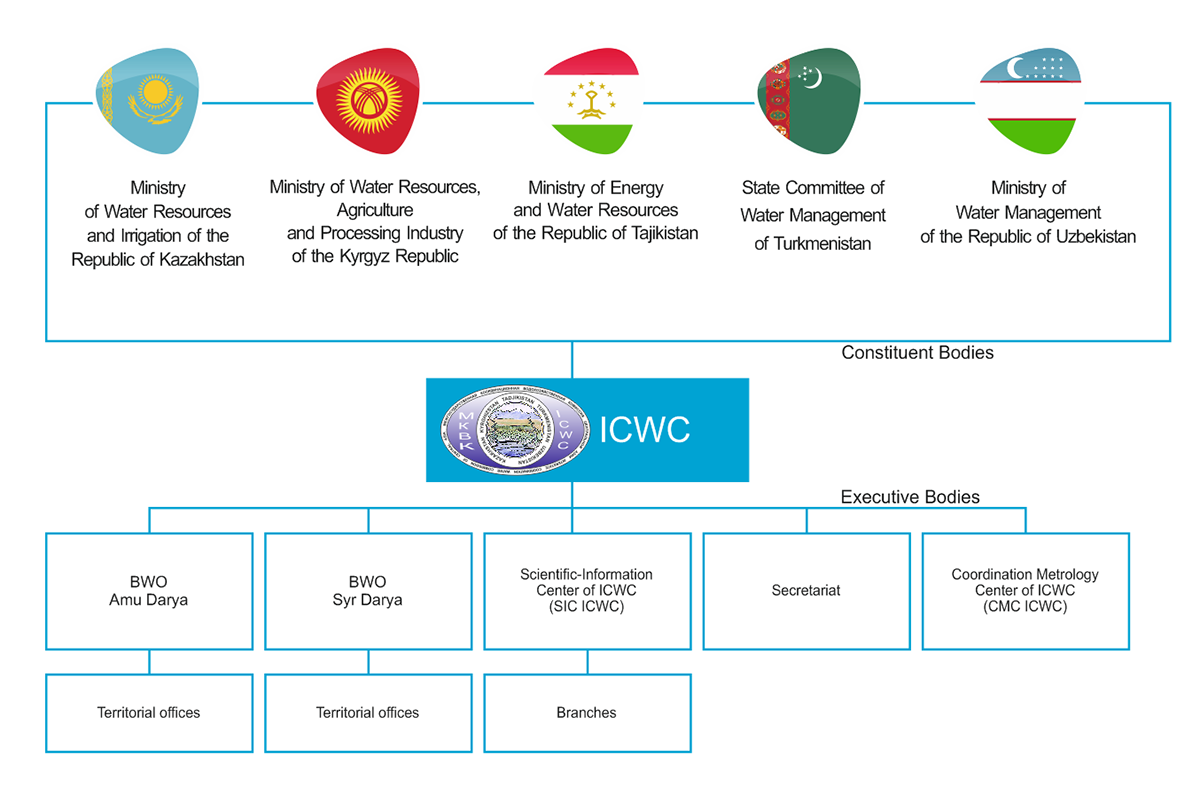
3.3.1. ICWC meetings
In 2024, ICWC held two meetings: 86th meeting (April 12, Shymkent, Kazakhstan) and 87th meeting (6 November, Ashgabat, Turkmenistan). ICWC members from Kazakhstan, Tajikistan, Turkmenistan and Uzbekistan , as well as executive bodies (SIC ICWC, Secretariat of ICWC, BWO Amu Darya, BWO Syr Darya) and invited participants took part in these meetings.
Agenda. The main items on the agenda were the limits/quotas of water withdrawal and the operation regimes of reservoir cascades in the basins of the Amu Darya and the Syr Darya rivers (use of such quotas in the past period and their approval for the next period).
The 86th meeting saw the approval of country-specific water quotas for the 2024 growing season. The Commission also reviewed the projected operating schedules for reservoir cascades and instructed both BWOs to ensure continuous oversight of these systems.
The 87th meeting finalized the country-specific water quotas for the 2024–2025 non-growing season. Additionally, the Commission reviewed and adopted the projected reservoir operation schedules proposed by both BWOs.
Following up on the initiatives from the IFAS Summits (2018 and 2023), the meetings highlighted the work of the ICWC and its executive bodies. To ensure continued progress, members were tasked with providing updated reports on their achievements, specifically targeting the strengthening of regional cooperation.
The meetings also underscored the need to strengthen training initiatives at both regional and national levels. SIC ICWC was tasked with partnering with international organizations to ensure timely access to information on regional seminars and to publish relevant materials on the ICWC website (86th meeting).
Source: ICWC
3.3.2.Activities of ICWC Executive Bodies in 2024
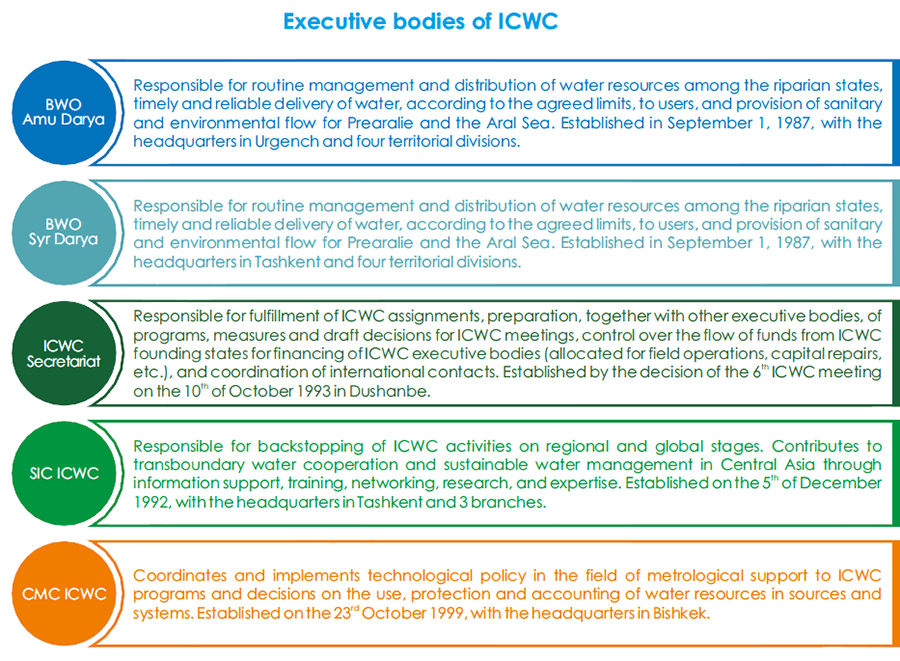
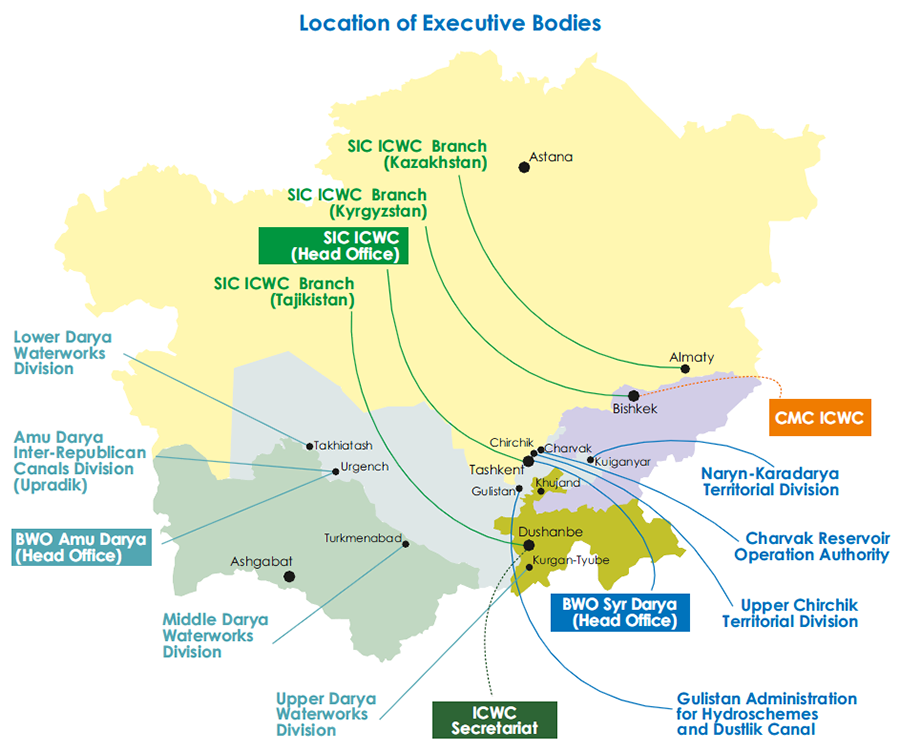
BWO Amu Darya
Activity in 2024
BWO Amu Darya continued working on: (1) distribution of water among the states and and real-time monitoring of compliance with the water withdrawal limits/quotas approved at ICWC meetings (see "Water-management situation in the Amu Darya and Syr Darya River Basins"); (2) improvement of the technical condition and operation of BWO Amu Darya structures; (3) preparation of materials and participation in two ICWC meetings (see "ICWC meetings"). Seventeen meetings were held among the heads of water management organizations responsible for the river’s lower reaches to address water allocation issues. Throughout the year, BWO Amu Darya continued cooperation with the water agencies of Tajikistan, Turkmenistan, and Uzbekistan, as well as with hydrometeorological services, SIC ICWC, IWMI, and GIZ.
Source: BWO Amu Darya
BWO Syr Darya
Activity in 2024
BWO Syr Darya and its territorial branches kept maintaining waterworks facilities, including canals, gauging stations, communication facilities, buildings and other structures under responsibility of the organization to ensure the efficient use of water resources and trouble-free and sustainable supply of water to user-states.
Collective governance. BWO Syr Darya, in coordination with the members of ICWC and other stakeholders, develops the projected operation schedules of the Naryn-Syrdarya reservoir cascade (NSRC) and water withdrawal limits for non-growing and growing seasons and also coordinates water allocation among water-user states in the Syr-Darya basin in line with the approved limits.
Mr. Y. K. Auzbekov, representing the Kazakhstani Ministry of Water Resources and Irrigation, serves as Deputy Head of BWO Syr Darya. In this capacity, he is responsible for the matters related to transboundary water management and water delivery to Kazakhstan.
ICWC meetings. BWO Syr Darya assissted in preparing the 86th (April 12, Shymkent) and 87th (November 6, Ashgabat) ICWC meetings. The organization submitted reports for review and approval regarding the projected and actual operation of the Naryn-Syr Darya reservoir cascade. These included water withdrawal limits for the 2024 growing season (based on forecast and actual water availability), as well as actual data for the 2023–2024 non-growing season and forecasts for 2024–2025. In preparing these reports, BWO Syr Darya utilized data provided by UzHydromet, CDC "Energy," the Ministry of Water Management of Uzbekistan, and the Ministry of Water Resources and Irrigation of Kazakhstan.
Repair and rehabilitation. Territorial branches of BWO Syr Darya completed scheduled repairs and rehabilitation of hydraulic structures, dam restoration, and canal dredging. Additionally, routine maintenance of dispatch office buildings was conducted in line with the approved work plan.
Reconstruction and modernization. In accordance with the investment program established by Presidential Resolutions: (1) No. PP-404 (dated 25.12.2023), "On measures to develop the social and production infrastructure of the Republic of Uzbekistan for 2024–2026": Stages 3 and 4 of the project to reconstruct and modernize the Dustlik Canal headworks in the Bekabad district of Tashkent Province were completed as per the approved design and cost documentation; (2) No. PP-454 (dated 24.12.2024), "On measures to develop the social and production infrastructure of the Republic of Uzbekistan for 2025–2027": Design and survey works have commenced for the reconstruction of the Uchkurghan Hydroscheme in the Uchkurghan district of Namangan Province.
ASBP-4. The financing is sought for implementation of the following projects included in the ASBP-4: (1) 1.3. "Ensuring dam and large hydraulic structure safety in Central Asia: capacity building and regional cooperation"; (2) 1.6. "Automation of water distribution, accounting and monitoring in the Syr Darya Basin. Development of national water information systems as the basis for the regional information system".
Source: BWO Syr Darya
ICWC Secretariat
Activity in 2024
The ICWC Secretariat, in collaboration with other executive bodies, contributed to the organization of two ICWC meetings (see "ICWC meetings") and ensured the implementation of ICWC decisions and directives.
Source: ICWC Secretariat
Scientific-Information Center of ICWC
Activity in 2024
IFAS. SIC ICWC took part in activities of the Working Group on institutional and legal improvement of IFAS, cooperated with EC IFAS, and exchanged information on ASBP-4 (see "EC IFAS"). SIC ICWC also worked on implementation of initiatives put forward by the presidents of CA states at the summits of IFAS Founder States in Turkmenbashi (2018) and Dushanbe (2023), and presented updates on the contribution of national water management organizations and ICWC executive bodies at ICWC meetings starting from the 77th meeting. At the invitation of the Chairman of EC IFAS, SIC delivered a presentation during the subregional session “Transboundary Water Cooperation in the Aral Sea Basin for a Better Future” held on the sidelines of the 10th World Water Forum (May 22, Bali).
ICWC Meetings. SIC, jointly with other ICWC bodies, contributed to two ICWC meetings (86th and 87th) and ensured the implementation of ICWC decisions and directives. For more details, please, refer to "ICWC meetings".
Analytics and assessments. Every ten days, SIC publishes analyses of situation in the river basins on SIC ICWC website, sections “Water management situation in the Amu Darya River Basin” and “Water management situation in the Syr Darya River Basin”. The analytical reports on water-management situation in the Amu Darya and Syr Darya river basins were prepared for the non-growing season (2023-2024) and growing season (2024); key figures of these analytical reports were streamlined with the data provided by BWO Amu Darya and BWO Syr Darya. Using satellite images, SIC estimates inflow from the Amu Darya and collecting drains to the Aral Sea, the water surface, wetland and dried areas within the Large and North Aral seas and lakes of the Aral Sea region.
The Center renders information and expert assistance to national and regional organizations on the matters related to transboundary cooperation, water security, policy and law, sound water use, climate adaptation, the Qosh Tepa Canal in Northern Afghanistan, water use forecasting, status of water bodies, PPPs in the water sector, etc.
CAWater-Info, Central Asian Water and Environmental Knowledge Portal. SIC provides information support to the ICWC and its executive bodies through the CAWater-Info Portal , which marked two decades in 2024. By the end of 2024, the Portal contains 82.35 GB of information . The Portal garnered 1.23-1.69 million Google search hits, with 17 600-28 100 clicks every month.
Modernization of the Portal, which was started in 2023, continued in 2024. This included new adaptive design of the ICWC website, improved the web design of the ICWC Training Center website and of the knowledge bases "International and National Water Law", "Land Law" and "Reclamation and Irrigated Agriculture". A new section No. 16 "Energy" was added to the thematic rubricator. New data were added to the CAWater-Info database: (1) water withdrawal (limits/quotas and actual) from the Amu Darya and the Syr Darya (by BWOs’ structures) for 2024; (2) actual water withdrawal from the Chirchik and Karadarya rivers for 2023-2024; (3) inflow to the Aral Sea and the Amu Darya Delta for the non-growing season 2023-2024 and the growing season 2024; (4) analysis of water-management situation in the Amu Darya and Syr Darya basins for the growing season 2024 and non-growing season 2023-2024; (5) results of RS-based monitoring of the Aral Sea water surface and littoral area; (5) land use, economic indicators, and reservoir operation in 2023.
RIS started to be transferred to www.cawater-is.net. New blocks and web-pages Demography and Glossary were developed and populated.
Scientific cooperation and research. In 2024, SIC worked on 10 projects in cooperation with the Innovative Development Agency of Uzbekistan, OECD, IHE-Delft Institute for Water Education, UNDP Country Office in Turkmenistan, BWO Amu Darya, Russian Foreign Trade Academy of the Ministry of Economic Development of RF, the University of Tokyo, the Central Asia Institute for Policy, Innovation and Zones (CAIPIZ) under the We-ACT Project (GIZ). 6 of these projects successfully completed. Resulting from the research efforts, SIC staff published 16 articles, including in GEP, E3S Web of Conferences, Agricultural Systems, INBO, as well as in scientific journals of Uzbekistan and the Russian Federation.
Research focused on the following key areas:
Transboundary cooperation, law and diplomacy
Support was provided for the development of proposals and materials related to strategic cooperation between the region’s countries, the Regional Strategy for Rational Use of Water Resources, and regional water and energy security. The achievements and challenges of transboundary water management in Central Asia, as well as the need to strengthen existing agreements, institutions, and cooperation mechanisms, were presented at various events. These included the workshop ‘Data Sharing as a Basis for Building Trust’ (January 17-18, Delft), the regional seminar on water diplomacy (April 9, Ashgabat), the workshop ‘The Phenomenon of Convergence in International Law’ (June 25, online), and the international roundtable ‘Development of Water Law in Central Asia’ (November 19, online) and others.
Expert discussions on cooperation between CA countries and Afghanistan, particularly concerning the Qosh Tepa canal, were advanced through presentations of analytical materials at: (1) the international conferences ‘Current Trends in Afghanistan: Implications for Central Asia’ (February 20, Tashkent) and ‘Afghanistan under Taliban Rule – Reaction of Neighboring Countries and Great Powers’ (August 27, UWED, Tashkent); and (2) the round table ‘Central Asia and Afghanistan. Visions of a Common Future’ (September 11-12, Termez). An analytical study ‘Relations between Afghanistan and Uzbekistan in the area of water sharing" was prepared under contract with the University of Tokyo.
Collaboration with the Academy of Water Law at Wuhan University (PRC) is developed. SIC ICWC representatives participated in the online workshop ‘The Phenomenon of Convergence in International Law’ (June 25) and the international conference ‘Rethinking the Concept of “Community” in International Water Law’ (June 26). Work also continues under the IHE-Delft project "Cross-regional learning for transformative water diplomacy" (CroWD).
Adaptation of water and land use to changing conditions
Research continued at pilot sites in Muynak and Ellikkala districts of Karakalpakstan, focusing on the adaptation of modern water and land monitoring systems, the modeling water balance (crop water requirements) to address salinization and improve land productivity in the Aral Sea region.
Environmental issues
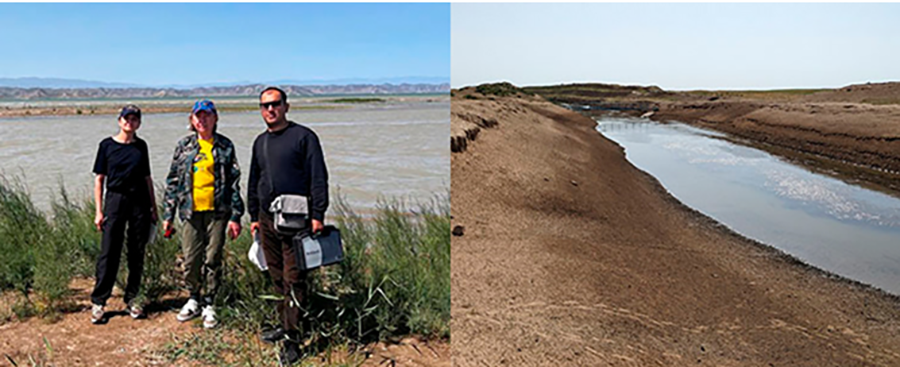
SIC conducted an expedition to study the Aidar-Arnasay Lake System from April 29th to May 4th. The findings of this expedition were distributed to relevant agencies in Uzbekistan and subsequently published in the journal ‘Economy and Socium’, Issue 9 (124), 2024.
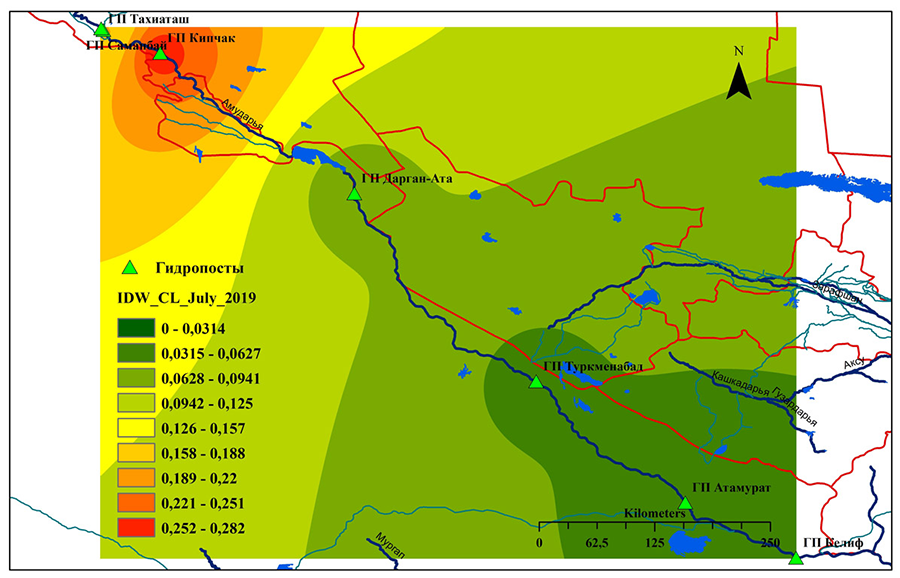
Research was conducted on ‘Environmental flow in legislation and practices in Uzbekistan and measures for improvement’, ‘Current hydrological and hydrochemical regime of the Amu Darya River’, and ‘Natural conditions of Sudochie-Akpetki sanctuary’. GIS maps for visualization of water salinity dynamics along the Amu Darya River were generated for 1991-2022.
Jointly with national experts of CA countries, under the GIZ-funded project "Research on Priority Issues in the Field of Water, Energy, and Environment in the Amu Darya and Syr Darya River Basins" a ‘Joint work to preserve ecosystems of the Amu Darya River Basin, including zones of flow formation and dispersion’ was initiated to develop measures for their sustainable functioning and conservation.
Water, energy, land and ecosystem nexus and water financing
SIC, in partnership with the OECD and UNECE and with the participation of experts from Central Asian countries, is implementing the project “Regional Mechanisms for a Low-Carbon, Climate-Resilient Transformation of the Energy-Water-Land Nexus in Central Asia”/IKI. As part of this project, SIC has initiated the modernization of the CAWater-Info Portal, the development of recommendations for financial mechanisms to support water-energy cooperation in Central Asia, and the creation of a modeling framework for quantitative assessment of economic benefits of regional cooperation on the energy-water-land nexus. Additionally, the project focuses on developing practical tools for effective nature management, including hydromodule zoning, crop water requirement calculations, and the assessment of territorial water security in the Aral Sea Basin. Furthermore, SIC is working on a proposal for the establishment of a Regional Center of Excellence, based on the SIC Training Center and the Expert Platform on Water Security, Sustainable Development, and Future Studies.
SIC contributed to the OECD's "National Dialogue on Water in Uzbekistan" project by assessing the investment climate for water sector development in Uzbekistan.
A side-event “Finance and Investment for Water, Energy and Land-use Nexus in Central Asia” (June 11, Dushanbe) and a scientific-practical conference "Water in Central Asia: The Future in Cooperation" (November 8, Tashkent) were held jointly with OECD and UNECE. SIC took part in the 3rd meeting of the Regional Working Group on the Mutually Beneficial Water-Energy Mechanism as part of the Green Central Asia Initiative (December 10, Tashkent).
Flow planning and regulation through advanced data and tools
Through control measurements accomplished in partnership with BWO Amu Darya at key gauging stations and canals in the Amu Darya middle reaches, a methodology for calculation of water balance’s elements within the Kelif g/s – Darganata g/s reach was updated. SIC assisted in drafting recommendations for effective distribution of water resources in the Naryn and Kara Darya river basins in the context of account climate change.
SIC made forecasts of water availability in the Zaravshan, Vakhsh and Naryn rivers using the MODSNOW program, explored modeling of the Syr Darya and Amu Darya river basins with WEAP and PyWR models, and analyzed innovative devices for automated water accounting in irrigation and drainage systems of the Republic of Uzbekistan.
As part of cooperation with the University of Manchester, SIC staff received training on the Python Water Resources (Pywr) Planning Model, culminating in certification for its application in the Chirchik River Basin (Tashkent, November 11-13). Furthermore, SIC signed a contract with the World Bank to model the water-energy nexus using adjusted WEAP and LEAP models.
Water, heritage and culture
Research on water heritage of Central Asia continued in 2024. The video-record titled “Water Governance in Central Asia: Lessons from the Past” on the value of past water management systems for present and future generations was presented at the scientific symposium of the ICOMOS International Scientific Committee on Water and Heritage “Water and Heritage: Bridging Divides and Connecting Past, Present and Future” in Pune, India (August 7-10, Pune, India). At the meeting of the Expert Platform on Water Security, Sustainable Development, and Future Studies, the thematic area “Water and Heritage in Central Asia” was proposed as the main research theme for 2025 (November 9, Tashkent).
Gender in water
SIC contributed to the development of the draft 2030 Gender Concept for the Water Sector of the Republic of Uzbekistan.
SIC, as a member of the Women in Water Management Network in Central Asia and Afghanistan, reported at: (1) 2nd Global Forum of the Women in Water Diplomacy Network (March 4-7, Vienna); (2) a session “Introduction to the Water-Energy-Food-Ecosystems (WEFE) Nexus: A Comprehensive Overview and Opportunities in the Central Asian Region” (May 17, online); (3) the Youth Seminar “Drops of the Future” (September 4-7, Almaty); (4) a seminar “Climate Change Agenda and Gender Dimensions” (December 10, online); (5) 2024 ‘Year-in-Review’ online event of the Women in Water Diplomacy Network (December 17).
SIC participated in the seminar of the GIZ project “Regional Approaches to Development Policy on Gender Equality in Central Asia” (August 29, online); the thematic session “Blue Ocean: New Opportunities for Women” of the Fourth Eurasian Women's Forum (September 19, St. Petersburg); in the work of the expert group on developing a roadmap for “Advancing the women, peace and security agenda in Central Asia” (September 23-24, Almaty).
Capacity Building. In the course of the year, SIC held: (1) in partnership with SIC ICSD and UNDP Turkmenistan, workshops on integration of adaptation into water planning in Turkmenistan (March 11-12, March 13-15, and April 8-9). A teaching guide to the trainers “Integration of adaptation into water planning in Turkmenistan” was published; (2) jointly with IWMI, a dialogue on transboundary water management and a seminar “Transboundary water cooperation: paving the way from Fergana Valley to South Asia” (June 24-27, Tashkent, Andizhan and Fergana provinces); (3) in partnership with OSCE Office in Astana, a workshop “Safety of hydrotechnical constructions” including a field trip to the Upper Chirchik waterworks facility and the Charvak reservoir (July 22-24, Tashkent).
The Center’s experts delivered lectures: (1) for the staff of the Institute of Legislation and Legal Policy under the President of the Republic of Uzbekistan on “Transboundary water use: legal aspects” (May 10); (2) within the framework of “Training on water diplomacy for the teaching staff of higher education institutions of Central Asia” (August 5-16); (3) at the seminar for the BISA’ staff (November 13, “Suvchilar Maktabi”/“School of Water Workers”). On a regular basis, practical trainings for farmers and design engineers on “Hydraulic design of drip irrigation” were organized in “Suvchilar Maktabi”/“School of Water Workers”.
Collaboration is maintained with the “Central Asian Journal of Water Resources Research”, e-journal “Actuarial finance and accounting” and the international journal “The World Economics & Finance Bulletin.” Dinara Ziganshina is a member of the International Water Law Academy, and Sh. Muminov has been serving as a member of the Scientific Seminar of the Academic Council (No. DSc.03/10.12.2019.I.16.01) at the Tashkent State University of Economics since 2023.
Regional and international cooperation. SIC ICWC contributed over 60 presentations to various regional and international events throughout the year. In particular: (1) at the 10th WWF (May 18-24, Bali), SIC representatives participated in the launch event of the UNESCO/UNITWIN Network on Climate Awareness (May 20); the sessions on “Enhancing Water Security through National Dialogues on Water” and “Water Information Systems” (May 21-22); the session on transboundary water cooperation in the Aral Sea Basin (May 22); “Hydrodiplomacy in transboundary basins” and on basin water management (May 23) and others; in the high-level event dedicated to basin management (May 23); (2) at COP29 (November 11-22, Baku), SIC participated online in two sessions “Sustainable Water Resources: Innovation and Technology,” organized by the Ministry of Water Management of Uzbekistan and “One World – One Climate: Uniting Efforts for Transboundary Adaptation”.
Dr. Ziganshina (1) continued her work as a vice-chair of the Implementation Committee under the UNECE Convention on the Protection and Use of Transboundary Watercourses and International Lakes (Water Convention) and took part in several events (March 7-8, online; April 15-16 and April 17, Zambia; July 19, online; October 23-25, Ljubljana, Slovenia); as a member of WWC Board of Governors participated in 86th meeting (February 17-18, Istanbul) and 87th meeting (May 19, Bali), as well as in the meeting of the Working Group on “Water for People and Nature” (February 13, online); (2) is a member of the Organizing Committee and the International Scientific Committee for the IWRA’s XIX World Water Congress to be held in Marrakesh, Morocco on December 1-5, 2025.
As part of cooperation with: (1) UNECE, SIC ICWC was engaged in the 14th Meeting of the Parties to the Protocol on Water and Health (April 16-17, Geneva), in the revision of water quality standards for water bodies and the work of the interagency WG on the prevention of water pollution and tailings dam safety in Uzbekistan (September 24); (2) FAO, the Center took part in the preparation of a transboundary component of the project “Strengthening Integrated Water Management in the Amu Darya, Zarafshan and Panj River Basins” (GCP/SEC/11380P/GFF) under the FAO/GEF Programme Central Asia Water and Land Nexus (CAWLN) to restore ecosystems, improve nature management and increase resilience as part of GEF-8 programme; (3) UNEP, SIC ICWC participated in the 14th Meeting of the Conference of the Parties to the Bonn Convention on the Conservation of Migratory Species of Wild Animals (COP14) (February 12-13, Samarkand) 13 February) and in the preparation of the project proposal ‘Facilitating region-specific approaches to addressing climate and environment-related risks for peace and security’ in Central Asia ; (4) SPECA, the Center contributed to the 27th Session of the SPECA WG on Water, Energy and Environment (November 25, Dushanbe, online) and the SPECA Economic Forum 2024 “Green Development in the SPECA Region” with a presentation “Water-Energy-Food-Climate Nexus: Modernization of Information and Analytical Tools” (November 26-27, Dushanbe, online); (5) INBO, SIC ICWC participated in its General Assembly, panel session “Water scarcity: planning and tools for the quantitative management of water resources at basin level” with the report “Ecosystems during water scarcity in the Aral Sea Basin: planning and management tools” (October 7-9, Bordeaux, France), published articles “International Fund for Saving the Aral Sea: 30 Years of Regional Cooperation” and “Enhancing Coordination of Water and Energy Resources in Central Asia” in the INBO Newsletter, and supports the activities of the Network of Water-Management Organizations of Eastern Europe, Caucasus and Central Asia (EECCA NWO), one of the eight regional networks of INBO; (6) GIZ, SIC ICWC established cooperation in organizing meetings of the Regional Working Group on the mutually beneficial water-energy mechanism and contributed to discussions on implementation mechanisms of the Regional Climate Change Adaptation Strategy for Central Asia (RCCAS-CA) (May 13, SIC; May 30, online); (7) IWMI, the Center participated in workshops under the CGIAR NEXUS Gains Initiative (January 29, Tashkent; October 28-29, Andijan; November 14, Tashkent) and in the implementation of the Blue Peace Central Asia 2.0 (BPCA 2.0) programme carried out by IWMI, IUCN and CAREC; (8) ADB, SIC ICWC was engaged in the work on the upcoming CAREC Water Component projects (27 November) and on modelling the water-energy nexus through the PyWR model; (9) AFD (French Development Agency), SIC ICWC took part in preparation of the ASBP-4 project “Hydro-module Zoning of the Syr Darya River Basin Using Remote Sensing Data and Satellite Mapping Technologies to Adjust Water Consumption and Irrigation Regimes of Agricultural Crops Cultivated in the Region”.
Cooperation agreements were signed with: (1) the Agency for Space Research and Technology under the Uzbekistani Ministry of Digital Technologies on joint geoinformation and space research on water management, use and protection, ecology, environmental protection, and water and agricultural sector development; (2) the Korea Rural Community Corporation (KRC) on implementation of joint research projects and programmes in Central Asia in the field of water and irrigation (November 27).
Publications. In 2024, SIC ICWC produced 37 publications and 52 information bulletins.
Source: SIC ICWC
3.4. ICSD of Central Asia
The Interstate Commission on Sustainable Development (ICSD) was established in 1993 by a decision of the Interstate Council for the Aral Sea Basin. It is mandated to coordinate and manage regional cooperation in environmental protection and sustainable development across Central Asian states. The commission’s organizational structure and the locations of its executive bodies are detailed in the figures below.
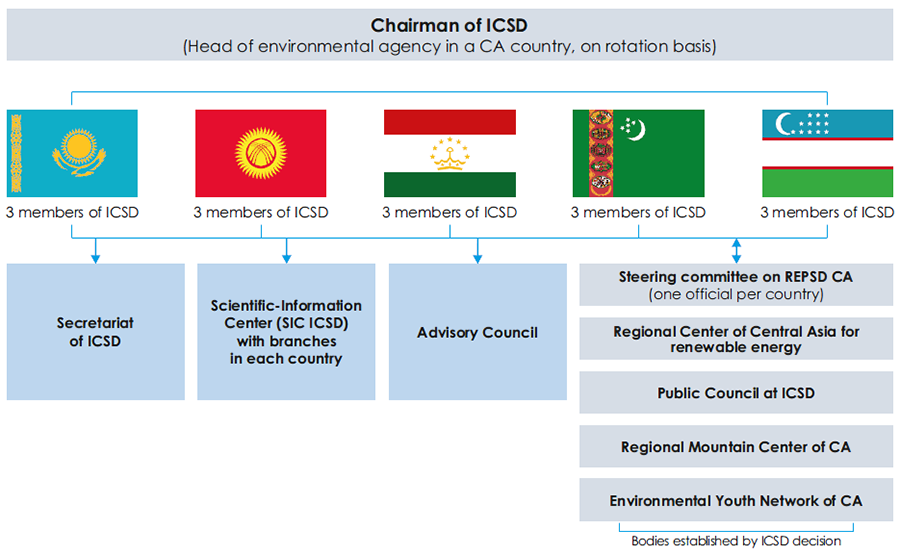
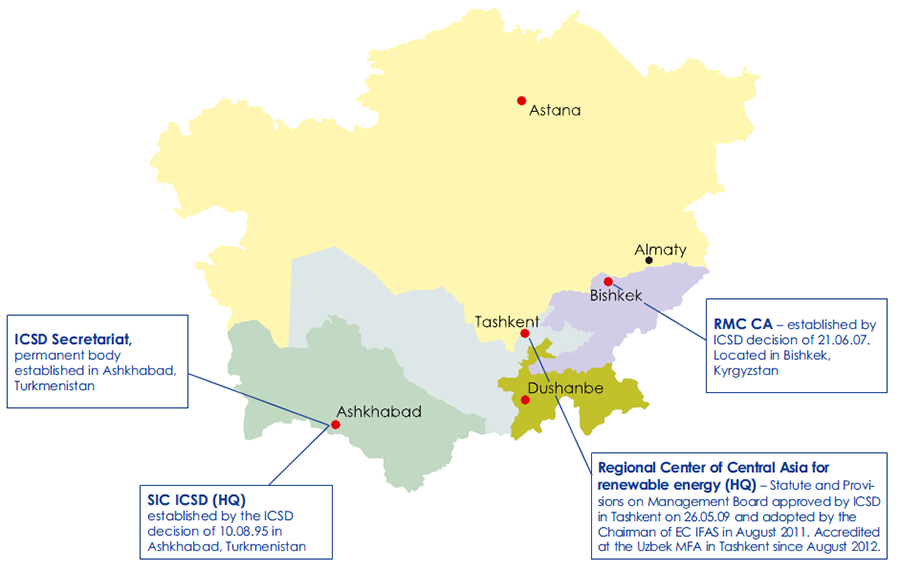
Following Kazakhstan’s 2022–2024 chairmanship, Tajikistan assumed the role for the 2024–2026 term during the ICSD meeting in Astana on March 28, 2024.
Activity in 2024
Improvement of the institutional and legal framework of IFAS. In 2024, ICSD took part in the 12th meeting of the respective Regional Working Group (September 4-5, Astana).
REP4SD CA. The REP4SD CA was approved at the meeting of the IFAS Board on February 22, 2022 in Dushanbe. The Program builds on ongoing regional processes aimed at achieving the SDGs, implementing UN environmental conventions, advancing the green economy, and adapting to climate change. As a strategic framework, the Program is designed to foster environmental cooperation across Central Asia through 2030. To drive progress, a Roadmap for 2021–2025 was developed to guide its implementation.
Projects. The following projects were completed: (1) “Development of a Comprehensive plan for the restoration of degraded desert pastures in the Central Karakums and their sustainable management in conditions of increasing drought” (FAO/GEF, 2023-2024); (2) “Elaboration and delivery of trainings on integration of adaptation into water sector planning in Turkmenistan” (UNDP, 2023-2024) as part of GGF “Developing a National Adaptation Planning Process in Turkmenistan”, jointly with SIC ICWC.
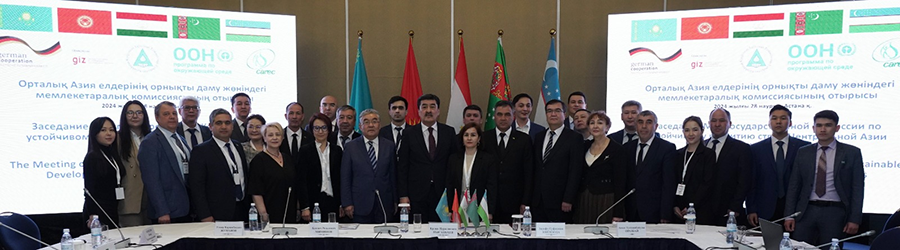
ICSD Meetings. During its 35th meeting in Astana, the ICSD approved the final report of Kazakhstan's 2022–2024 chairmanship and reviewed the status of previous resolutions. A key highlight was the Regional Mountain Centre’s report on the 2023–2027 Global Framework for Mountain Development. The formal handover of leadership to Tajikistan took place as well (March 28). Before this meeting, the Commission engaged with its Advisory Council, which brought together regional environmental officials and public stakeholders.
Events. A regional conference, marking the 30th anniversary of the ICSD, showcased the key achievements of the Commission and its Scientific Information Center (SIC) over the past three decades. The event also highlighted international partner initiatives focused on transboundary cooperation, Green Climate Fund (GCF) financing, and the empowerment of civil society (November 26, Dushanbe).
Representatives of ICSD took part in the following events: (1) Second Sub-Regional Workshop “Diagnostic Analysis Development on Cryosphere and Climate Change” (November 4-5, Almaty); (2) COP-16 of UNCCD (December 2-13, Riyadh, Saudi Arabia) and the Central Asia-Russia Interregional Group meeting (December 1-2), session of the Peace Forest Initiative (December 3).
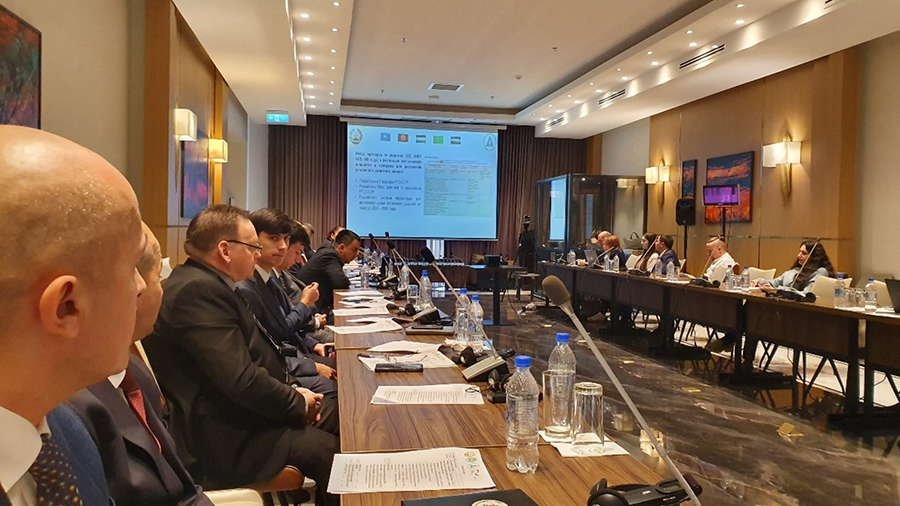
November 26, Dushanbe Source
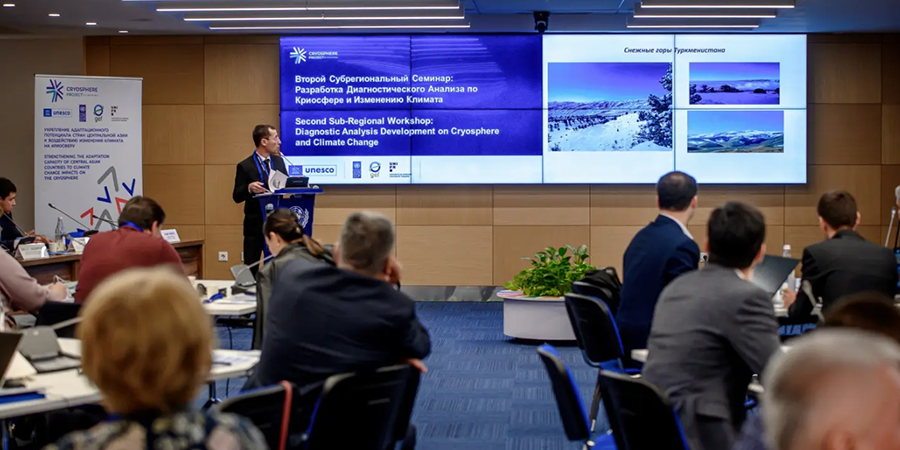
November 4-5, Almaty Source
Source: SIC ICSD
3.5. Regional Environmental Center for Central Asia
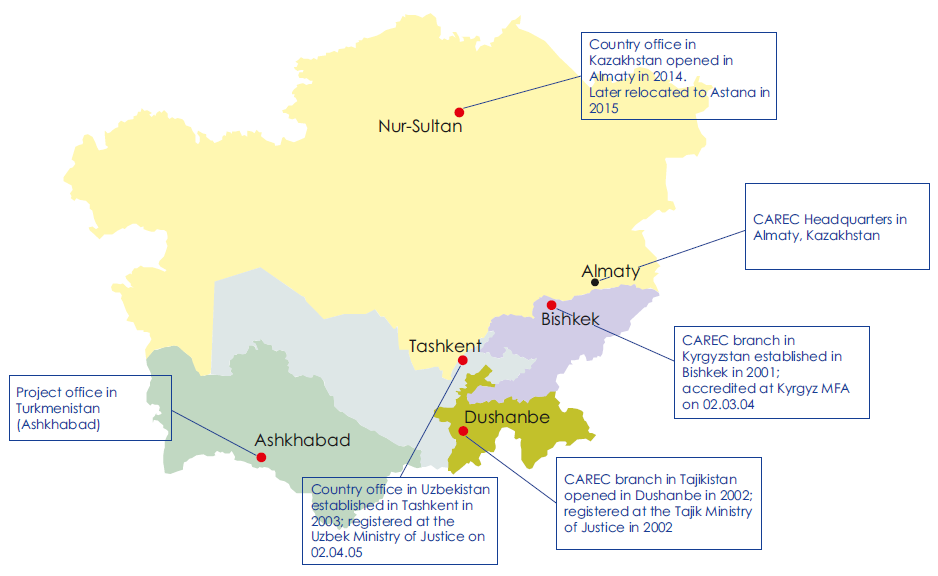
CAREC is an independent, non-profit, nonpolitical international organization, which assists the Central Asian governments, regional and international stakeholders and partners in addressing their environmental and sustainable development issues in Central Asia. The headquarters is located in Almaty, with the country offices operational in 5 Central Asian states.
Activity in 2024
Projects. In 2024, the following projects were completed: (1) “Development of the Environmental Code of the Republic of Tajikistan” (World Bank, 2023–2024); (2) “Increasing Economic Independence and Improving the Status of Women in Central Asia through Access to Irrigation Water and Infrastructure” (Coca-Cola Foundation, $500,000, 2023–2024); (3) “Capacity Development and Technology Transfer to Improve the Generation and Use of Data and Information in Support of Monitoring the Environment in Central Asia” (World Bank, $80,000, 2023–2024); (4) “Strengthening Coordination and Positioning of Central Asia in Global Climate Processes” (GIZ, €327,000, 2023-2024); (5) “Regional Approaches to Combating Sand and Dust Storms and Drought” (UNCCD, €588,000, 2020–2024); (6) “Climate Adaptation and Mitigation Program for the Aral Sea Basin”/CAMP4ASB (IDA, World Bank, $15 million, 2016–2024) ; (7) “Regional Climate Action Transparency Hub for Central Asia”/ ReCATH (ICAT , $991,654, 2021-2024) and others .
Within the framework of the project “Climate Resilient WRM in the Zarafshan River Basin”/ iCH2O (SDC, CHF 523,123, 2023-2026), the second meeting of the Basin Council of the Uzbek part of the Zarafshan River was held (29 November, Samarkand). Implementation also began for the ERASMUS+ project “Land Management, Environment & Solid-Waste: Inside Education and Business in Central Asia”/ LESLIE (EACEA, €359,850, 2024-2027), which is to develop higher education programs in the region
Capacity Building. A series of trainings was conducted as part of projects: (1) “Climate-responsive and gender-sensitive basin management” (October 15, Taraz; October 17, Shymkent; October 22, Bishkek; October 24, Osh; November 5, Tashkent, November 7, Khujand; November 19 and 20–21, Ashgabat; December 3, Khiva; December 5, Bukhara; December 18, Dushanbe); (2) ReCATH (March 11-15, Tashkent; June 26-28, Bishkek; July 2-4, Dushanbe; July 23, Istanbul. Additionally, ReCATH organized a series of online webinars (August 15, September 13, October 2).
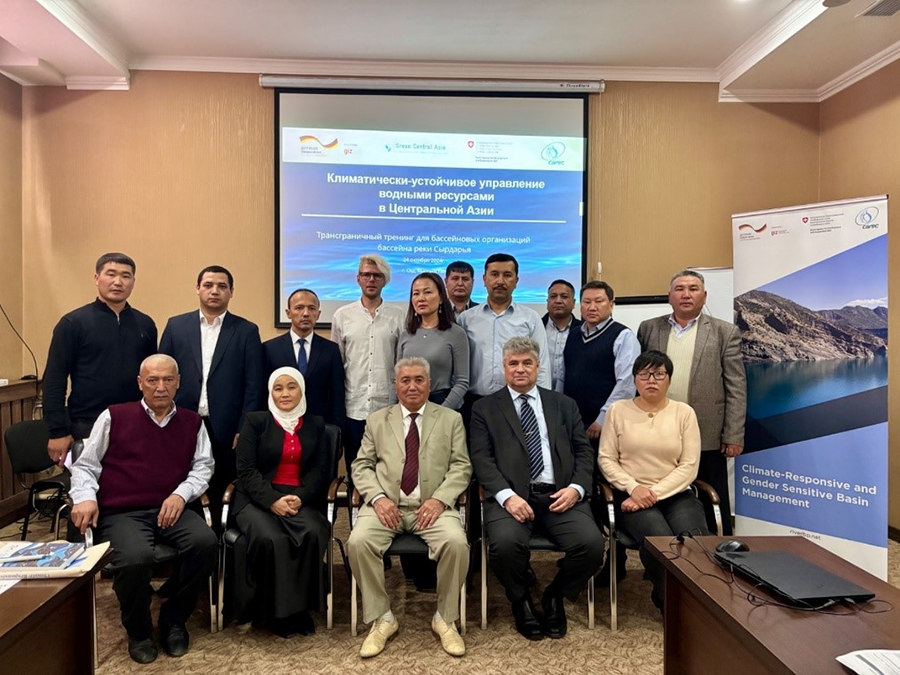
October 24, Osh Source
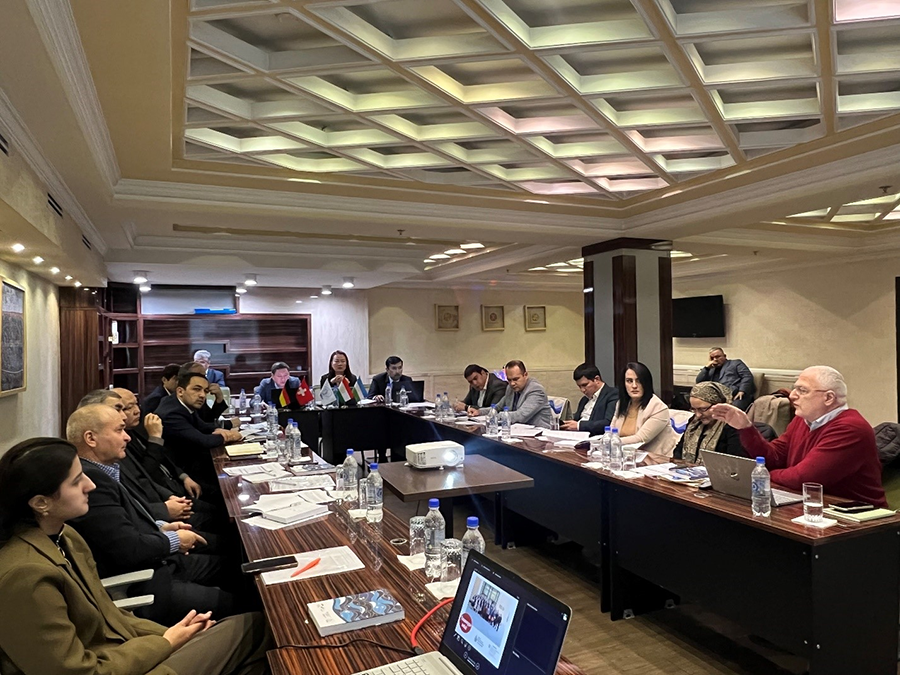
December 18, Dushanbe Source
Events. (1) Meeting “Central Asia at Climate Change Negotiations: COP28 Outcomes and Plans for COP29” (February 10, Tashkent); (2) Central Asian Climate Change Conference (CACCC-2024) “Bridging Climate Goals with Action: Making Ambitions a Reality” (May 27-29, Almaty); (3) 14th Central Asian Leadership Programme (CALP) “Glacier Horizons and Climate-Smart Mountain Disaster Risk Management in Central Asia” (September 10-13, Almaty); (4) regional workshop of the ReCATH Project (October 8-9, Tashkent); (5) two side events “Driving Climate Finance: Enhancing Transparency and Empowering NGOs” (November 15),“Enhancing Transparency of Climate Action in Central Asia: Lessons, Needs and Future Directions” (November 20) at COP29.
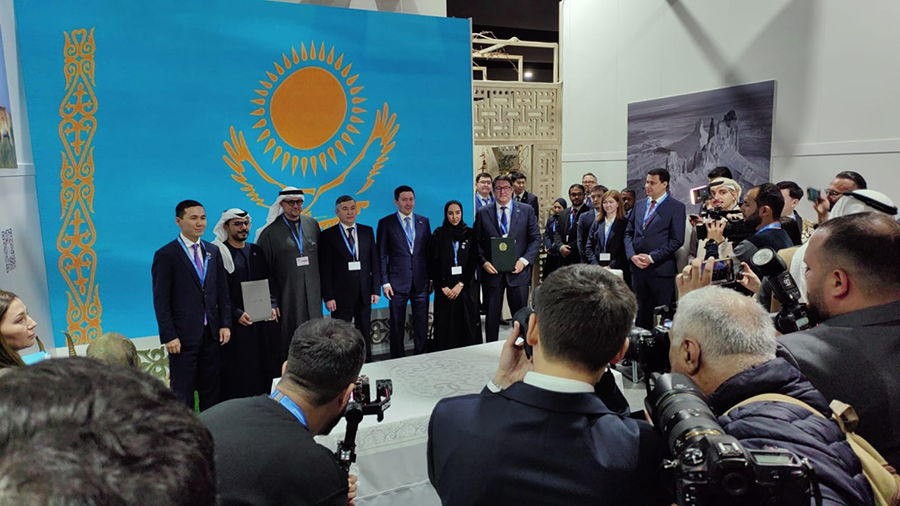
CAREC provided technical assistance in organizing Kazakhstan Pavilion at COP29.
In partnership with the OSCE Vienna Office and the Stockholm International Water Institute, CAREC continues supporting the Women in Water Management Network in Central Asia and Afghanistan. The Network’s key accomplishments and plans for 2025 were discussed at the annual online event “Year-in-Review” (December 26).
CAREC participated in: (1) ICAT Community Meetings 2024 (February 28, Bonn, Germany); (2) the Scientific and Practical Conference “Potential Use of Treated Wastewater for Irrigation of Agricultural Lands - Rational Solutions for Water Resources Protection” (August 7, Guliston, Tajikistan); (3) Second Sub-Regional Workshop “Diagnostic Analysis Development on Cryosphere and Climate Change” (November 4-5, Almaty); (4) COP29 (November 11-22, Baku); and others.
Source: CAREC
Development and support
Scientific-Information Center ICWC